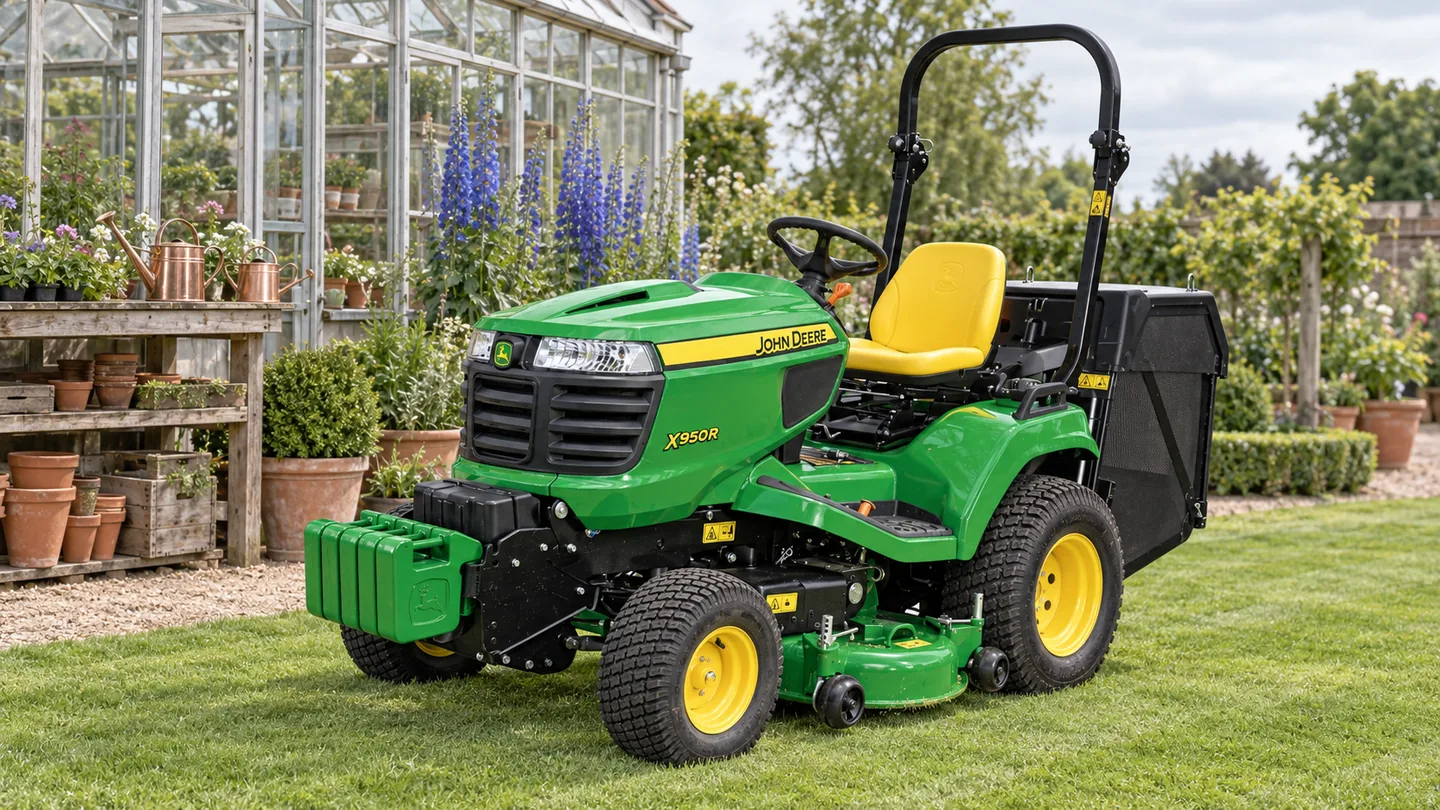
The John Deere X950R is a diesel mower with rear discharge and rear collection. Before comparing a used machine or buying service parts, identify its engine, rear deck and collector. A photograph or a “25.2 hp” heading does not establish all three.
Deere documents the X950R with 48-inch (122 cm) and 54-inch (137 cm) rear decks. Its Belgian X900 table lists 18.5 kW (25.2 hp) at 3,200 rpm, Stage V, Twin Touch two-wheel drive and a 14.5 km/h maximum forward speed. These are regional manufacturer specifications, not measured cutting speed or proof of a particular used tractor's build. .
Identify the tractor, deck and collector together
Ask for readable photographs of the tractor PIN plate, engine identification, deck identification and collector. Obtain the applicable operator's manual and current parts-catalogue application using those identities. Include any replacement engine, changed deck or retrofitted collector in the enquiry; the original tractor specification cannot establish what is fitted now.
Keep document versions separate. Deere's linked riding-equipment brochure describes an X950R at 18 kW/24 hp and 3,300 rpm, while the Belgian table above gives a different rating and engine speed. The documents do not establish the serial boundary between those descriptions. Use the actual engine plate and matching documentation rather than combining the numbers into one specification. .
The X950R entry specifies hydrostatic drive with Twin Touch pedals. A seller's reference to a “gear-drive option” needs correction or evidence identifying another machine. Likewise, a 60-inch side-discharge deck listed for a neighbouring X900 model is not evidence that it belongs on this rear-collection tractor.
Choose collection equipment around the unloading place
Deere lists a 570-litre low-dump collector and a 650-litre high-dump collector. The Slovenian lawn-care brochure also requires front weights for high dump. Confirm the actual weight package, brackets and installation against the applicable documentation; the capacity figure alone does not specify them. .
Start with where the clippings must go. Record the receiving container's height and opening, approach space and overhead obstructions. Ask the supplier to confirm the offered collector's unloading envelope and operating requirements for that arrangement. A larger hopper does not resolve an inaccessible unloading point.
For a used offer, itemise the collector, its mounts and controls, required weights and any supplied deflector or other conversion equipment. Ask which items are missing and obtain an installed-price quotation for completing the intended configuration. Do not assume that removing the hopper leaves a complete, approved discharge arrangement.
Measure access using the actual offered machine: narrow gates, turning areas, storage and transport. Collector configuration and added equipment affect the occupied space. A brochure's bare-machine mass or one overall dimension is insufficient for a trailer-loading calculation.
Match blades and belts to the fitted rear deck
The October 2023 X950R quick-reference guide separates the two deck sizes and right- and left-hand blade variants. Its entries include these distinctions:
| Dated guide entry | 48-inch rear deck | 54-inch rear deck |
|---|---|---|
| Right-hand blade, 20.5 / 26.5 mm variant | AM146397 / AM148485 | AM146399 / AM148487 |
| Left-hand blade, 20.5 / 26.5 mm variant | AM146398 / AM148484 | AM146400 / AM148486 |
| Two-belt set | AM143703 | AM143715 |
| Separately listed three-banded-rib belt | M177474 | M177474 |
. These are historical reference entries, not a current order confirmation. The sheet does not state a serial transition for the two millimetre variants or establish that they interchange.
Send the supplier the deck identification, tractor PIN, fitted part markings and clear photographs of the blade mounting arrangement or belt routing. Request the current application and any superseding number. Resolve an unmarked or conflicting assembly before ordering; matching the mower badge and nominal cutting width is insufficient.
Specify position and quantity separately. A two-belt-set description and a three-banded-rib-belt description identify different entries; neither establishes the contents of a particular seller's package. Have the quotation state the number supplied, associated hardware and any additional parts needed for the documented repair. Inspect a damaged drive system for the cause before treating a new belt as the complete repair.
Use the service chart as a document check
The same dated guide lists engine-oil replacement at 200 hours; its oil-filter row adds an annual limit. Primary and secondary air-filter entries show 600 hours or annually, and hydraulic oil and filter show 400 hours or two years. The printed oil and oil-filter time qualifications differ: do not silently turn them into one universal interval.
The applicable operator's manual must resolve first-service work, calendar limits, severe conditions, fluid specification and procedure. Match the engine and machine identities before choosing a kit. A guide's filter list does not prove that every listed item is due at the same service, nor that one advertised kit contains every required item.
This is a diesel machine. A petrol-engine spark-plug replacement schedule is not an X950R service task. If an advertisement or inherited maintenance list includes one, stop using that list as application evidence and identify the actual engine.
For a used purchase, ask for dated service records with hours, work performed and products used. Where records are missing, have the servicing dealer identify the work required before use and quote it separately. A clean machine and a reset reminder do not document completed maintenance.
Inspect the complete used machine before pricing repairs
Arrange an inspection and demonstration by a competent operator following the matching manual, in an appropriate clear area. Record whether the engine was already warm before arrival; ask for an agreed cold-start assessment rather than accepting a warm restart as equivalent evidence. Have a technician assess abnormal starting, smoke, leaks, warning indications or temperature behaviour.
Check the hydrostatic travel controls, steering, brakes, deck lift and engagement, collection and unloading as fitted. Establish that the intended work can be demonstrated without defeated interlocks or improvised controls. Do not bypass a safety device to complete a demonstration. An unresolved fault needs diagnosis, not an assumed adjustment cost.
Inspect the deck, spindles, blade mounting, drive components, collection path and hopper for wear, damage or makeshift repairs. A short run without grass cannot establish collection performance. If an appropriate mowing demonstration is unavailable, record that part of the assessment as unverified and price the offer accordingly.
Worksite suitability also remains a separate decision. Obtain the machine-specific slope, ballast and attachment instructions, then have the proposed use assessed against them. This guide supplies no universal slope percentage, towing load or fuel-consumption allowance. Hydrostatic control, a diesel engine or front weights do not by themselves approve a particular slope or towing task.
Compare complete offers and decide what remains unresolved
Ask for one written schedule identifying the actual tractor, deck, collector and required equipment, with serial or assembly evidence attached. List included accessories, unresolved faults, assessed repairs, missing components and installation costs. Confirm the seller's written warranty terms and exclusions where offered; do not infer coverage from the Deere badge or a historical brochure.
Compare the price of a usable configuration for your collection route, including delivery and the quoted work. Hold the order when identity, deck application, required collection equipment or a safety fault is unresolved. Proceed only when the documents, demonstrated condition and written offer describe the same machine and task.
This guide draws on manufacturer documents and an inspection framework. It does not report an owner test, a current sale price, a guaranteed running cost or an independently measured mowing result.
The attachments list is impressive — snow blower, front blade, cart, aerator. I’m mainly a four-season user and that versatility matters.
Quick question: does anyone know if the factory hitch supports heavier tow-behind equipment or do you need an aftermarket upgrade?
I upgraded to a stronger hitch when I got a heavy dethatcher — gave me peace of mind, but not strictly necessary for lawn carts and light spreaders.
Factory hitch handles typical tow-behind loads but for heavy-duty commercial attachments you might want a reinforced hitch. I can add towing capacity specs and recommended aftermarket options to the buying considerations section.
Also check PTO torque specs before hooking big attachments. Save your transaxle! (learned the hard way 😂).
Thanks — I’ll include a PTO torque note and a quick ‘when to upgrade the hitch’ guideline.
Okay this article did a good job but I’m skeptical about the ‘maintenance made easy’ claim.
I work on my own machines and from what I know, John Deere parts are solid but sometimes a pita to get without a dealer visit. Also the belt routing on some models is a pain — does anyone have pro tips for that?
Also, the mowing quality sounds great on paper but I want pictures of clippings before I fall in love. 😂
Great points Olivia. I’ll see about adding a short maintenance checklist and clearer photos of the belt/b deck area. Dealer parts access varies by region — some owners keep a small parts stash for common items like belts and filters.
Pics of clippings: look for mowing demos on YouTube. Lots of owners upload before/after shots — that helped me decide.
Belt routing: locker a few bolts on the idler, rotate slowly with a screwdriver to seat the belt, then tighten. Saves you a dealer trip for simple adjustments.
Also, if you’re comfortable, check the manual’s schematic. It helps demystify the routing so you don’t yank things apart blindly.
Update: I’ve added a short ‘owner tips’ box with belt and filter part numbers common to the X950R — should help with quick maintenance checks.
Agree on parts — I order filters online and keep a spare blade on hand. Saved me a weekend once.
Comfort section sold me — my old mower had zero suspension and my knees hated me. If the X950R actually cushions the ride like the article says, it’s worth trying.
Has anyone compared the operator station to the X700 series? I heard steering and responsiveness are different.
I rode both — X950R feels less twitchy at speed, and the seat on the X950R is a notch above the X700 in my opinion.
Short compare: X950R is heavier-duty with a sturdier frame and often better suspension options vs the X700. Steering feels a bit more planted on the X950R. I’ll add a quick comparison line in the article.
I appreciate the ‘Is the X950R the Right Choice for You?’ wrap-up. Helped me figure out whether to even test-drive it.
One awkward thing: the article assumes a medium-large yard. If you have a tiny yard, is this overkill? Pros/cons for small-property owners would help.
For tiny yards, consider a compact zero-turn or smaller garden tractor. The X950R is great but not terribly nimble in tight flower beds.
You’re right — for small yards the X950R might be more tractor than needed. I’ll add a small buyer’s guide note: pros for big properties and when a smaller model might be smarter (cost, storage, maneuverability).
Short and sweet: the cutting system section had me nodding. Looks like a good spread and decent mulching ability.
But I’m curious about blade change — tool-free? or the usual ‘get the wrench and curse’ routine?
Love the practical tips in the maintenance section. Short and useful.
One tiny nit: the article doesn’t mention warranty transfer if you buy used. That’s something people should know before purchasing a pre-owned X950R.
Can confirm: paperwork = peace of mind. Don’t skip it.
Also ask for maintenance receipts. A well-serviced used machine is worth more than one with zero paperwork.
I’ll also add a checklist for used buyers (VIN, receipts, wear items, test ride) — thanks for the suggestion!
Good catch, Emma. Warranty transfer rules vary by dealer and region — I’ll add a note advising buyers to confirm transferability with their local dealer and check for active service records.
Yup — always ask the dealer for a VIN check and active warranty status. Saved me from a nasty surprise once.
Price is what made me pause. Looks great feature-wise, but compared to other tractors I saw, the X950R seems premium-priced. Are the accessories worth it or are they mostly upsell?
LOL at the ‘operator experience’ bit — haha, anyone who hasn’t fallen asleep on a comfy seat hasn’t mowed enough. Jokes aside, is the service interval reasonable? Annual full service or every 100 hours?
I want something low-drama summer-long.
For casual homeowners, annual service often suffices, but if you’re mowing every week in tough conditions, go by hours.
Keep an eye on air filters more than anything — clogged filters will make everything feel sluggish.
Most preventive service items are recommended at 50-100 hour intervals depending on use (oil, filter, greasing). I’ll include a quick service interval table so readers can plan.
I love the look of the X950R — seems roomy and solid. A few thoughts after reading:
– The seat and suspension section convinced me it’s meant for longer jobs.
– Curious if anyone’s tried the 54″ deck in hilly turf? Stability’s my worry.
The article was thorough but I’d like to see more on real-world fuel usage. 😅
I run a 54″ deck on slopes similar to yours — it’s fine if you keep speed down. Biggest tip: watch tire pressure and add ballast if you really need grip.
Thanks Maya — good call on fuel. Manufacturer estimates are one thing, real lawns another. For moderate mowing the 25.2-HP engine usually does well; on hills you’ll see higher consumption. If you want, I can add a short section summarizing reported fuel economy from owner forums.
I second the seat comfort — saved my back. Would still test-ride before buying tho. Some models feel different after 20 min.
Anyone else worried about electronic controls long-term? Simplicity is nice — fewer sensors, fewer headaches. But the article made the tech sound fancy. Does that equal more to fix later?
Valid concern. The X950R balances mechanical and electronic parts; some comfort/monitoring features are electronic but the core drivetrain is mechanical. I can add a short section outlining which features are electronic and what owners should watch for over time.