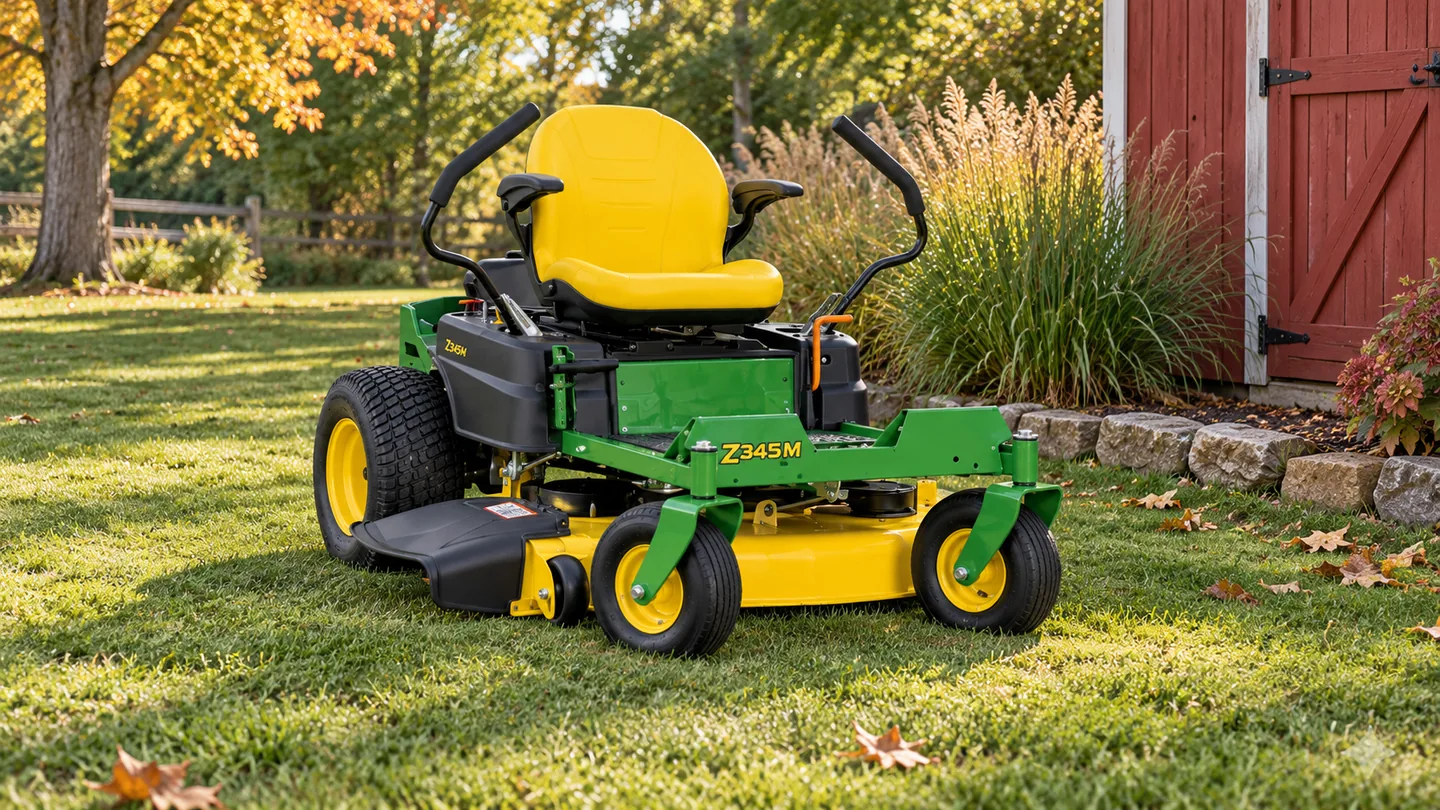
For a used John Deere Z345M, identify the mower and fitted deck before judging the listing or planning storage. A deck’s cutting width does not establish the machine’s overall width or its clearance through a turn.
This guide uses Deere documentation and contains no on-machine measurements or mowing trials.
Documented configuration: Z345M with 42A
The 2020 North American Deere operator’s manual OMUC28756, Issue K0, lists Z345M. It covers serial numbers 160001 onward. Printed page 52 lists a Briggs & Stratton 44N677 engine and Hydro-Gear EZT-C transaxles for Z345M. Page 53 gives the following values for Z345M with 42A. .
| Item | Documented value |
|---|---|
| Cutting width | 42 inches |
| Machine width | 50.5 inches |
| Machine height | 40.1 inches |
| Machine length | 72.3 inches |
| Weight with mower and full fuel | 497 lb |
Check that the offered machine falls within that document’s scope before applying its specifications. Earlier machines and replaced engines or decks require their own verification. A collector or another fitted accessory also needs to be included in the dimensions you check.
Equipment & supplies
Access measurement for Z345M ZTrak Residential Zero-Turn Mower
Measure the complete machine and every restriction on its route; cutting width alone does not establish clearance.

Komelon Self Lock tape measure
Record accessible ground-level dimensions for an equipment and site discussion with a dealer or rental provider.

As an Amazon Associate I earn from qualifying purchases.
Check the route into the lawn and storage
Record the narrowest usable opening, including gate hardware and posts. Check the approach and turning space on both sides, then compare the route with the mower’s measured dimensions in the configuration you intend to move. Keep guards and safety devices in place.
Follow the route all the way to the parked position. A shed can have enough floor space and still have a restricted doorway or turn. Resolve clearance with the seller or delivery provider before paying for delivery; published width alone does not confirm clearance through a turn. Use the storage arrangement and procedure permitted by the applicable manual. Upright parking is not recommended by this guide.
Turn listing claims into evidence requests
Ask the seller for the mower and fitted-deck identification, plus an itemized list of accessories included in the price. Retain the identification details privately with the written offer.
The Product Identification section on printed page 3 of the same manual keeps separate records for the machine’s product identification number, engine serial number and left and right transaxle serial numbers. Record any difference between a component label or seller’s description and the reference. Have the installed component identified before ordering parts.
| Listing statement | What to request |
|---|---|
| “Original engine” | Engine identification and any replacement or repair history. |
| “Ready to mow” | Recent service records, known faults and the terms of an inspection. |
| “Mulching included” | The actual components and their documented application to the fitted deck. |
| “Fits through the gate” | Measured machine dimensions and the configuration used for that measurement. |
Replacing the fitted deck? Use the 42-inch deck identity and replacement guide to check the offered assembly and included components. Its cutting width alone does not confirm fit.
Record the Z345M serial branch for engine-service supplies
What serial range accompanies the LG276 reference?
Deere's 2019 maintenance-kit cross-reference lists Z345M, serial 040001 onward — LG276. Read the tractor serial number before using that row as the starting point for a kit purchase, then confirm the installed engine and current parts reference.
For a tractor serial below 040001, this row supplies no answer. Use documentation that covers the actual machine rather than extending the listed range backwards. An operator's manual can also have its own applicability range; check the range of the document being used for each task.
The LG276 row selects an engine-maintenance reference. It does not establish that Z345M and Z345R blades, belts, decks or attachments are interchangeable. Identify those assemblies separately when adding them to the same order.
Equipment & supplies
Z345M engine-kit listing to verify

John Deere LG276 maintenance kit
The documented LG276 branch starts at Z345M serial 040001. Confirm the tractor serial and installed engine before checking this offer. The cross-reference gives no kit answer for an earlier serial.

As an Amazon Associate I earn from qualifying purchases.
Keep condition questions separate from diagnosis
Record starting problems, unusual vibration, leakage or uneven drive response as unresolved condition questions. A seller’s explanation does not establish the cause. Obtain a qualified inspection of the work needed before comparing the offer with a sound alternative.
For service planning, find the and match the engine, deck and transmission documentation to the equipment now installed. Use that documentation for oil capacities, service intervals, tire pressures and blade work.
When the other offer is a Z345R
Keep the model suffix intact and compare the equipment fitted to the two actual machines. Ask about differences in controls, seat equipment and included accessories. Adding an accessory to a Z345M does not change its model identity; an R suffix alone does not establish the condition or value of an offer.
Use the Offer Scope Check in the buying guides to record included equipment and missing information. The Parts Request Brief helps prepare an identification question. Return to John Deere Mowers to compare equipment types.
About the comments below: they are not inspection findings for the mower you are considering. Check any operating or repair advice against its applicable manual.
Short and sweet: looks like a good residential zero-turn. The deck options are what matter most to me. Curious about mulching performance though.
Nice write-up — I was on the fence about stepping up to a zero-turn and this article really helped.
I like that they covered comfort and routine maintenance in detail. The controls section made me feel like I could actually try one out without getting lost.
One thing I’d add: how does it handle tall, wet grass? Anyone tried that?
Also curious about long-term ownership costs — mower itself seems solid but I’d pay attention to deck wear and belts.
Good job overall, solid comparisons vs other residential models.
Thanks, Alice — glad it helped. We didn’t have extended wet-grass tests in this piece, but the deck design and discharge options generally do better with regular clipping frequency. Worth asking dealers about demo runs.
I used a similar-sized ZTrak last season in damp conditions and it held up fine. Slow your ground speed, cut a bit higher, and you’ll avoid clumping.
Agree on the maintenance point — belts and spindles can sneak up on you if you don’t keep an eye.
Not impressed. Seems overpriced for what it offers compared to other brands in the same segment. Warranty fine, but dealer markup killed the deal for me. Also felt like the maintenance intervals were a bit optimistic — I want to see 3-4 years of real-world reliability before recommending.
Really liked the section on deck design and grass management. A couple of things that stood out:
1) The cut options and adjustability seem well thought-out for folks who want both bagging and mulching.
2) The seat and armrest notes are accurate — comfort matters on longer jobs, and vibration damping makes a difference.
3) On routine maintenance: don’t sleep on spindle wear. That can affect cut quality fast, and it’s not always cheap to fix.
Also, I would have liked more pics of the underside of the deck — shows vs tells, ya know?
Overall, seems like a solid mid-range residential zero-turn if you want a blend of power and comfort.
Pics would be clutch. Sometimes photos of wear points help you spot cheap components before buying.
Good tip, Mark. We’ll include aftermarket accessory notes in the buying guidance section too.
Agree on spindles — replaced one last summer after hitting a concealed rock. Ouch.
Anyone tried the mulching kit? I’m tempted but worried about power loss when bagging vs mulching thick patches.
Thanks Hannah — great practical points. We do plan to follow up with a gallery of deck underside shots and maintenance hotspots.
Also check for aftermarket deck reinforcement options if you have debris-filled yards. Saved my deck twice.
Mostly positive take here — I liked the comparisons to other residential models. A few quick notes:
– If you have lots of trees and tight turns, the zero-turn will shave hours off trimming time.
– For simple yards, a lawn tractor might still be cheaper and easier for hauling stuff.
– The article’s ownership-cost section was honest; no flashy promises.
Also, lol at the paragraph about sounds and rumble — who knew mowers could be ‘symphonies’ 😂
Good distinction about when a lawn tractor still makes sense. That’s a decision many readers overlook.
Agree — I almost bought a zero-turn but my yard needed a little more hauling capability. Went with a hybrid and I’m happy.
Hah, ‘mower symphony’ made me smile. But yeah, practical advice wins here.
If hauling is a must, look at tow-behind solutions for ZTraks — they add versatility without sacrificing the cut.
Question for folks who’ve owned one: what’s the best way to winterize a ZTrak like the Z345M? I’m in a cold climate and want to avoid nasty surprises come spring.
Looking for practical tips — fuel stabilizer, battery storage, deck care, etc.
Thanks in advance!
Great question. Short checklist: add fuel stabilizer and run the engine for a few minutes, change oil/filter if due, disconnect and store the battery in a warm spot, clean and protect the deck (light coat of oil or spray protectant), and lift/relieve belt tension if recommended by the manual. Cover it and store on a flat surface.
I also jack the wheels slightly to take load off the tires for long storage and spray spindle bearings with a light protectant. Works for me.
Don’t forget to clean out the mower deck — damp clippings can rust the deck over winter. A little wax afterward goes a long way.
Does anyone know if dealers will demo a Z345M on a real yard? Can’t commit without feeling the seat and steering.
Most dealers will arrange a demo or at least a short test ride — call ahead and ask to see a unit with the deck and options you care about. Bring your checklist (comfort, turn radius, deck lift) and take 10–15 minutes on it.
Whoever named it Z345M clearly wanted to sound like a spaceship. 😂
Jokes aside, looks like a practical choice for a guy with a mid-size yard and no patience for trimming around flower beds. Did anyone test the control responsiveness? Some zero-turns feel like wrestling an octopus at first.
It took me one afternoon to get comfortable. The key is small, deliberate inputs at first — then it becomes second nature.
We found the steering to be predictable; once you get used to the solo-lever feel it’s pretty intuitive. Good point about the learning curve though.
Loved the “operator comfort” section — my back would thank me. A few thoughts:
– If you have slopes or lots of tight obstacles, remember zero-turns trade some hill capability for maneuverability.
– The accessory guidance was actually useful; not just a laundry list. 👍
– Price vs ownership costs: I wish they’d included more real-world maintenance costs or common replacement parts so people know what to budget for.
Also found a tiny typo in the buying guidance paragraph (maybe double-checked that?). 😅
Typos are proof humans wrote it, right? 😂 But seriously, budgeting for spindle work + belts saved me a headache.
Appreciate the suggestions — we’ll see about adding a short maintenance cost checklist in a follow-up.
Totally agree on the slope thing. I swapped to a rear-engined mower for a steep lot — zero-turns are awesome on flats but can feel sketchy on banks.
Thanks for the catch, Maria — we’ll review that paragraph. Good point on slopes; the article tries to cover the balance between agility and hill performance but it’s worth calling out explicitly.
If anyone’s budgeting, ask local dealers about common service packages — they gave me a 2-year plan that covered most stuff for a fair price.