Updated
Before choosing a John Deere snowblower attachment, identify the tractor, the blower and the parts that connect them. A width label or a photograph cannot show whether a sale includes the hitch, support, drive components and controls your proposed setup needs.
Use the eight checks below to request a complete quotation. Keep unknown items open until the seller or a John Deere dealer resolves them against the actual equipment and current documents.
1. Start with the tractor you own—or the one you plan to buy
For an existing tractor, record the full model and PIN, then photograph its identification plate and existing front attachment hardware. For a new tractor, ask the supplier to identify the proposed machine and its relevant options on the quotation. A series name leaves too much unresolved.
If you already own part of the equipment, list it separately from the items being purchased. Ask which existing components can be retained after their identities and condition are checked. Reusing a tractor may change the buying decision; it does not establish that a particular blower will fit.
Record:
- tractor identity.
- existing attachments and hardware.
- proposed new items.
- person verifying the combination.
2. Ask for a complete package, not just a blower body
Request an itemized list covering the blower, hitch, attaching support, PTO and drive components, upstop, hydraulic connections and controls as applicable to the identified combination. Ask the supplier to mark each line as included, already owned and verified, additionally required, or unresolved. Ask for the applicable ballast requirement to be identified in the matched documentation.
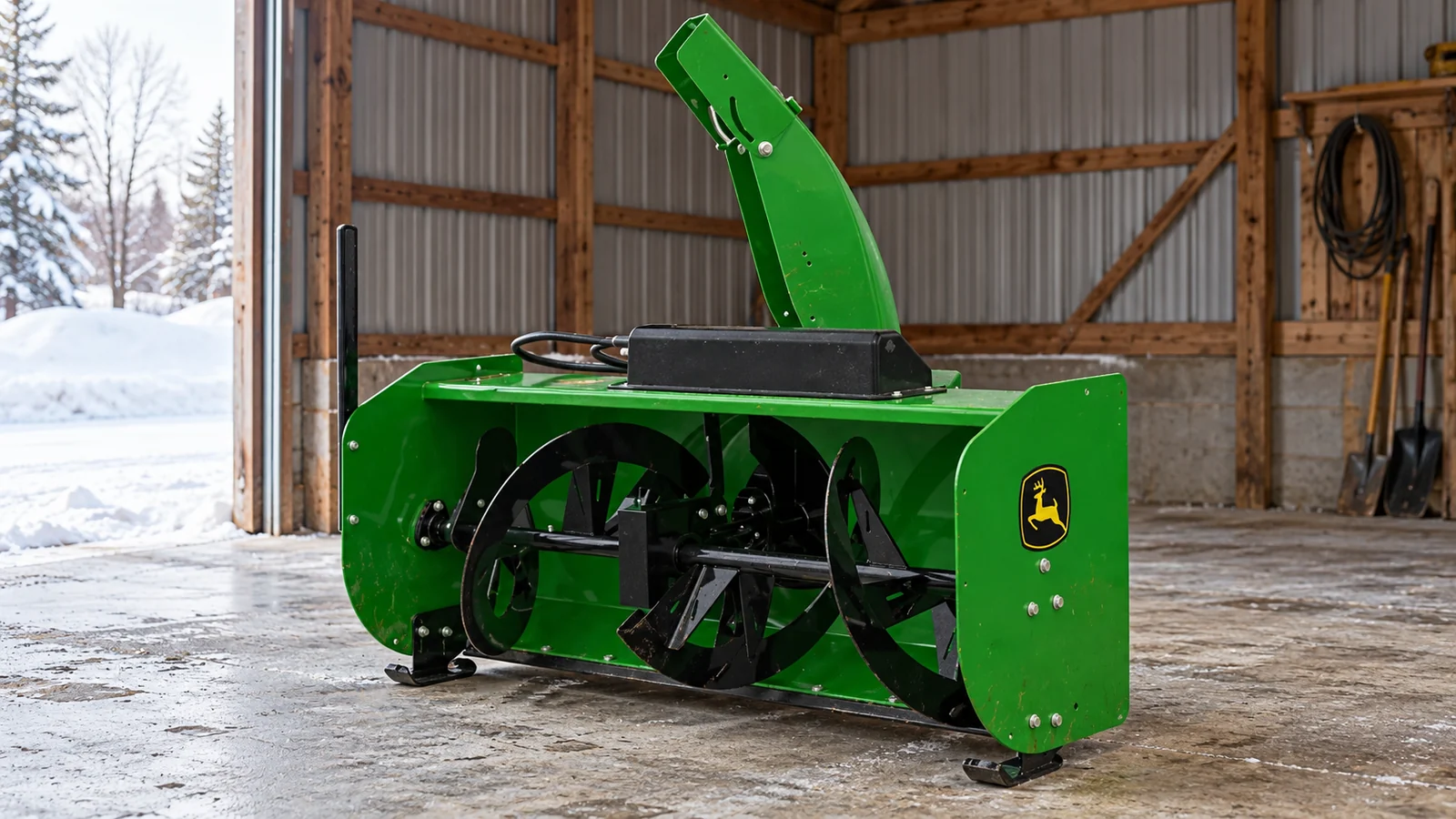
The lists the 1475M 47-in. (119-cm) Quick-Hitch Snow Blower separately from the front quick-hitch, front PTO, upstop and drive shaft. Its compact-tractor notes also call out a dual selective control valve and front attaching support, with further support and ballast requirements referred to the Sales Manual. This describes that document’s offering; it is not a current fit list for every 47-inch blower.
The same schedule distinguishes front-hitch option 6952 for listed 1025R tractors without a single-point hydraulic connector from option 6956 for listed 1025R tractors with that connector. The latter includes two flat-face coupler pairs. The tractor model name alone therefore leaves a material configuration question unanswered. Use the document to frame the question, then obtain current confirmation for the actual machine.
Record:
- included components.
- verified existing components.
- additional requirements.
- unresolved items and document references.
3. Match clearing width to an identified assembly
Write down the offered blower’s complete identification, not just its nominal width. Deere’s contains several 47-inch snowblower model/serial groupings. It also explains the product/configuration identification and serial-number limits used in parts listings. A shared width is not evidence that two used attachments have the same mounting or parts requirements.
Ask the supplier to confirm both the documented clearing width and the overall dimensions of the proposed installed arrangement. Treat them as separate entries. Do not select a width from property size alone while the tractor, connection hardware or access restrictions remain unresolved.
Record:
- blower identity.
- clearing width.
- installed dimensions.
- current document and verifier.
4. Measure access and storage before accepting the arrangement
Record the narrowest gate or doorway, the route into storage and the space available for the tractor with the proposed equipment. Note corners, door travel and where a detached attachment would be stored. Compare these observations with dimensions confirmed for the actual configuration; do not substitute the clearing-width label for its full envelope.
If the supplier cannot establish that envelope from the identified equipment or documents, keep access and storage as unresolved quotation items. This worksheet supplies no universal clearance allowance, turning radius or slope limit.
Optional access and storage measuring accessory
Optional general measuring accessory. Confirm equipment dimensions with the supplier; no attachment fit or safe clearance is established by this tape.

Komelon SL2825 25-foot tape measure
Record accessible gate or doorway widths and storage-space dimensions for the buying worksheet. Compare them with supplier-confirmed equipment dimensions; the tape does not establish attachment fit or a safe clearance allowance.

As an Amazon Associate I earn from qualifying purchases.
Record:
- narrowest opening.
- route constraints.
- installed storage space.
- detached storage space.
- unresolved dimension.
5. Specify controls, attachment changes and support
Ask how lift, chute rotation and deflector adjustment are provided on the offered setup, including any separately required controls or connections. Do not infer these from the width or assume that an attachment described as quick-hitch includes every part needed to use it.
Ask the supplier to explain the exact configuration and the matching operator documents before purchase. Record who will resolve installation questions, demonstrate the supplied controls where appropriate, and support the equipment afterward. A seller’s description of easy operation is not a substitute for those answers.
Record:
- functions and control equipment.
- included connections.
- matched instructions.
- support contact and outstanding questions.
6. Compare quotations line by line
Use the same scope list for each offer. A bare attachment price and a complete delivered package total are different quotations. Request separate lines for the identified equipment, additional mounting or drive hardware, installation or setup work, delivery, and any applicable charges. Ask the seller to state what is excluded and which requirements remain unresolved.
For used equipment, also request the identification records, included loose components and available service history. A photograph of an assembled machine does not inventory what will be transferred with the sale. Keep the scope and document dates with each offer; this guide provides no current prices, stock claims or ranked best buy.
Record:
- offered items.
- excluded items.
- work and delivery.
- unresolved requirements.
- quotation date and contact.
7. Obtain matched manuals and a parts route
Request the operator documents for the actual tractor and attachment, plus documentation for the mounting and drive equipment being supplied. Have the supplier identify the editions or document numbers that apply. A parts illustration helps identification; it does not replace assembly or operating instructions.
Before accepting a used package, ask how its identity, missing pieces and service needs will be checked. Do not transfer a generic oil, lubrication, belt or winter-storage routine to an unidentified attachment. The matched manuals must determine the applicable procedures and intervals.
For future parts, retain the full identification record and the person or dealer who will verify current numbers against the relevant serial range. PC1926 expressly describes serial limits and advises verifying part numbers with a dealer when ordering. Its identification guidance supports that process, not an assumption that the same-width machines share all parts.
Record:
- tractor manual.
- attachment manual.
- mounting and drive documents.
- serial-specific parts contact.
- missing records.
8. Choose the next step from the unresolved items
Do not turn an incomplete worksheet into a purchase recommendation. Return the unresolved identity, hardware, dimensions or documentation questions to the seller or dealer and keep the answers with the quotation.
Once the equipment has been identified, use the mounting-package worksheet for installing a John Deere snowblower to organize its component and document records. Use the winter route and crew worksheet for site planning and handoffs. Neither link supplies universal fit or operating instructions for an unidentified package.
Record:
- unresolved item.
- person answering.
- document or next worksheet.
Honestly, do I really need a snowblower attachment when I can just shovel? I mean, sure it’s work, but nothing beats the old-school method. Plus, it’s a workout! 😅 What’s the point of over-complicating things?
Hey Rick, shoveling is great exercise for sure! But if you live in an area that gets a lot of snow, the snowblower can save you time and energy for other activities. ⛄
Exactly, Rick! Shoveling is cool until it’s 3 AM and snowing, and your driveway is a mountain! 🤣
Nice breakdown of the snowblower attachments! But seriously, why do they all look so similar? It’s like they just change the color and call it a day. 😒 I didn’t see anything too groundbreaking in the picks. Anyone else feel like they’re all just rehashing the same stuff?
Thanks for your input, Gabe! We try to highlight the best performers rather than just the looks. It’s all about efficiency! Keep the feedback coming!
I get what you mean, Gabe, but it really comes down to performance. Some attachments just work better than others, even if they look the same. It’s about how they handle the snow! ❄️
Yeah, I guess looks aren’t everything. I had a cheap one that looked cool but performed terribly. I’ll take function over form any day!
Loving this article! I had no idea about the maintenance tips for snowblower attachments. I always neglected mine and wondered why it didn’t work as well! 😂 Definitely gonna start taking better care of it now! Anyone have tips on cleaning the blades?
Great tip, Marky! Keeping the blades clean does prolong their life and maintain performance. Thanks for sharing!
Thanks for the suggestion, Marky! I’ll definitely try that out this weekend.
So glad you found it useful, Betty! For the blades, I usually spray them off with the hose after every use and dry them well to prevent rust. Super easy and effective!
Hey everyone! Just finished reading the article and I’m super pumped to try out one of those snowblower attachments. My old one just doesn’t cut it anymore, especially after last winter! ❄️ I’m leaning towards the one with the heated handles — do any of you have experience with that feature? Is it worth the extra cash? 💰
Great to hear you’re excited, Tommy! The heated handles definitely enhance comfort, especially during long sessions. I say go for it!
Hi Tommy! Yes, the heated handles are a game changer! Last winter I did not freeze my fingers off, which was a huge plus. Totally worth it for those really cold days! 🌨️