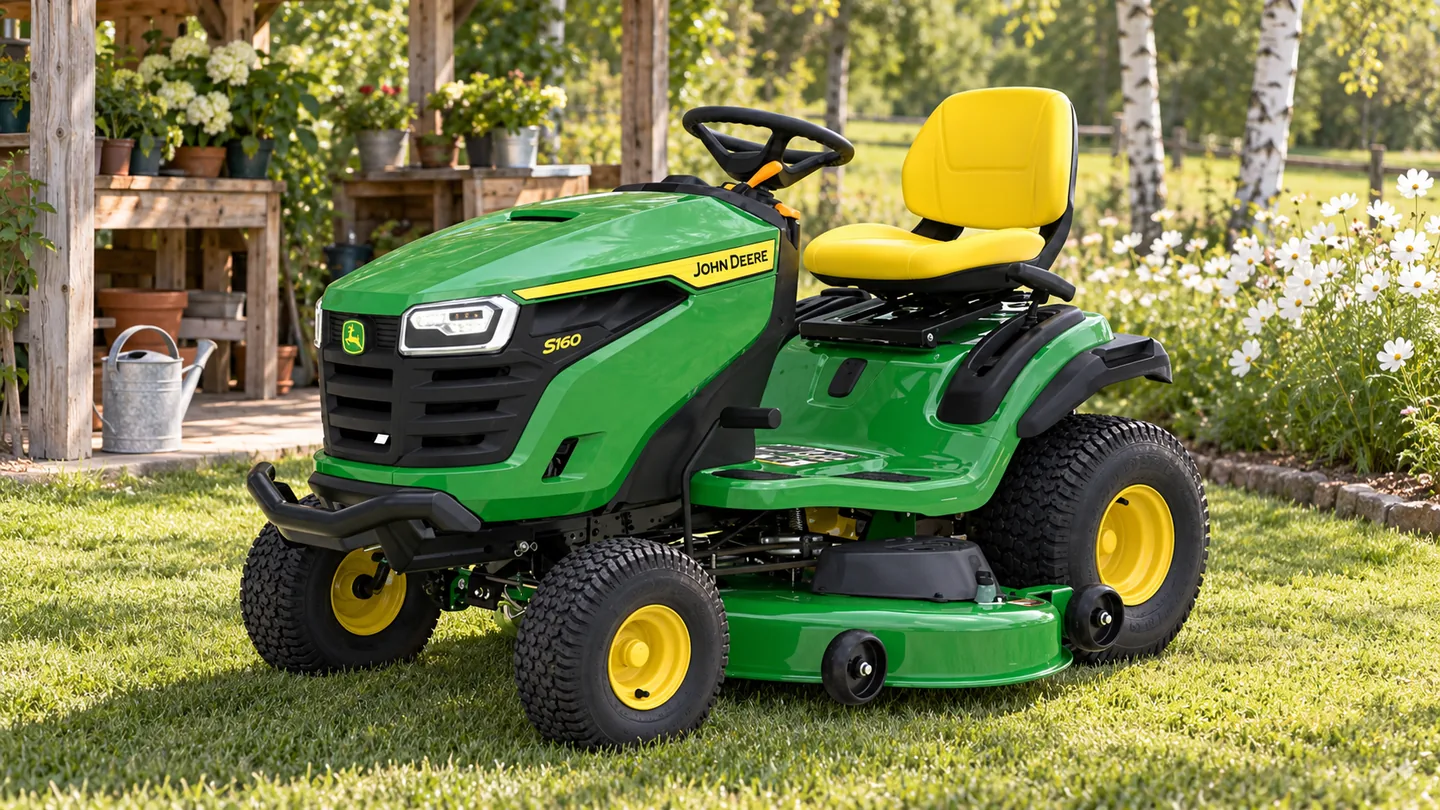
Start Smart with the John Deere S160
We’ll show how our 24 HP John Deere S160 combines power, comfort, and reliability, and guide us through safe operation, efficient mowing, routine maintenance, and troubleshooting to keep the tractor performing like new season after season, with confidence and ease.
What We Need Before We Begin
We’ll need:
Familiarize Yourself with Controls and Safety Features
Is this the most user-friendly lawn tractor we’ll ever operate? Let’s find out.Walk around the S160 and identify the main controls before you start.
Locate these controls and learn what each does:
Check critical safety systems and fluids.
Test the neutral safety switch and seat interlock by trying to start with the PTO engaged or with the seat empty; the engine should not crank in unsafe conditions. Inspect the ROPS and seat switch for secure mounting. Check engine oil and hydraulic fluid levels, confirm fuel is fresh gasoline and the cap seals, inspect battery terminals for corrosion, and verify tire inflation to the placard PSI.
Adjust the seat and mirrors for clear sightlines. Clear the mowing area of rocks, toys, and branches. Wear eye and ear protection, sturdy shoes, and avoid loose clothing to prevent entanglement.
Perform Pre-Start Safety Checks and Fueling
Why a two-minute routine now saves hours of headache and repair later.Before we turn the key, run this quick, consistent pre-start checklist to avoid problems and protect components.
We verify that the parking brake engages and that PTO (blade engagement) control is off before starting. These quick steps reduce restart problems and extend component life.
Start and Operate the Tractor Smoothly
Smooth, confident starts — even if the tractor’s been idle all winter.Sit in the operator seat and confirm the parking brake is set; we keep hands free of controls while preparing to start.
Set the PTO to off and place the throttle/choke in the manual’s recommended start position.
Ensure the key is turned to preheat/glow (if required) and then to start; let the engine catch and run.
Let the engine warm at low throttle for 30–60 seconds; we listen for unusual noises and check gauges for normal oil pressure and temperature.
Check that the headlights, brake, and PTO indicators behave normally before moving.
Use the hydrostatic drive slowly: press the forward pedal/lever gently to accelerate and release it smoothly to slow.
Press the reverse pedal only after coming to a complete stop; we pause, glance behind, then reverse with caution.
Control ground speed by keeping lower throttle for mowing and higher throttle for transport; for example, mow at a steady, comfortable pace that keeps the blades cutting cleanly.
Steer gradually and reduce speed for tight turns; approach slopes by mowing up-and-down where practical, avoid sudden turns, and never leave the seat with the engine running or PTO engaged.
Set and Use the Mower Deck and Attachments
Get a crisp, even cut — and swap accessories without breaking a sweat.Select deck height based on grass type and conditions; choose lower for fine fescue and higher for Bermuda or tall, wet grass. Use the height adjustment lever and measure both sides at the blade tips to confirm evenness — for example, set to 3″ on both sides to avoid scalping.
Engage the PTO smoothly by bringing engine to low throttle, then switch PTO on and increase RPM slightly; test blade engagement briefly at low throttle and listen for balanced rotation before mowing.
Mow at about one-third of the remaining blade height per pass to avoid scalping; overlap passes 2–3 inches for consistent lines. Use straight lines for speed and neat appearance; use staggered or offset passes to manage heavy clippings or uneven turf.
Attach baggers, mulch kits, or carts by following pins and connector alignment, secure safety chains, then torque fasteners to spec.
Lower RPM and disengage blades when crossing driveways, gravel, or obstacles to prevent damage. Transport the deck raised, latch or block it securely for maintenance, and always chock the tractor before working under the deck.
Perform Routine Maintenance to Extend Life
Ignore this and the tractor will remind us painfully — preventive care keeps resale value high.Change engine oil and filter after the first 5 hours (break-in), then every 50 hours or annually; for example, mowing weekly usually hits ~50 hours twice a season.
Sharpen blades in early spring and again mid-season; for example, remove nicks and balance on a blade balancer or a nail in a wall. Inspect belts during each oil change and replace at the first sign of glazing or fraying. Keep a maintenance log with dates and engine hours, and use OEM parts when possible. Prepare the tractor for winter by stabilizing fuel, removing and storing the battery indoors, and protecting the deck and exposed metal with a cover.
Troubleshoot Common Problems Quickly
Dead battery? Clogged deck? We can fix most nuisances without a mechanic — here’s how.Start with simple, safe checks and escalate only when needed. We list fast actions you can do in your driveway to isolate common faults.
Keep Mowing Confidently
We’ll keep our S160 reliable and efficient with routine checks, safe operation, and simple maintenance; try these steps, test improvements on your next mow, and share results with us so we can learn — start today and enjoy easier lawns.
Not a mower guy usually but this guide was super approachable. The troubleshooting part saved me — that odd vibration turned out to be a bent blade.
Pro tip: keep a spare blade on hand. You’ll thank me later 😂
Glad the troubleshooting helped. Bent blades are surprisingly common — and always good to have a spare.
Spare blade = must. Also balance them after sharpening if you can, prevents new vibrations.
Where do you buy OEM blades? I always frett about fitment.
Loved the safety section. As a first-time tractor owner, the step-by-step on controls was clutch.
Quick q: anyone else find the PTO engagement a bit jerky at first? Any tips to make it smoother?
Yes! I eased the throttle and it smoothed out. Also check the belt tension — loose belt = jerky engagement.
Glad that section helped, Maya. For PTO engagement, try engaging at a slightly higher idle and make sure blades are at the right height per the guide.
I gotta admit I skimmed until the maintenance section and then realized I was doing a bunch of stuff wrong (air filter mostly).
Follow the guide — change that filter regularly, folks. Your engine will thank you.
Air filter maintenance is one of those small things that makes a big difference. Appreciate the reminder.
Same — I found dirt packed in there from last season. Cleaner machine = better performance.
I tried the maintenance schedule and honestly my mower runs quieter now.
Question: For oil changes, do you recommend synthetic or conventional for the S160? I mow about once a week on medium-size yard.
I use synthetic and it’s been fine for two seasons. Slightly pricier but fewer changes needed imo.
Either works if you follow the recommended interval. Synthetic offers better temperature stability and longer life, but check the manual for viscosity recommendations.
Short and sweet: loved the attachments part. Hooked up a bagger for the first time and it works like a charm.
One tiny criticism: bigger photos or a diagram of attachment points would be helpful.
Bagger is game-changer. Saves so much time clearing clippings after a long mow.
Thanks, Ava — we’ll look into adding clearer diagrams for attachment points in the next revision.
Agree on diagrams. I second that request!
Minor gripe: would have liked more about winter storage. The article mentions it briefly but no nitty-gritty.
Like, do I fog the engine? Stabilize the tank? Drain the deck? Lots of choices and I ruined an engine once from bad storage, not telling a story 😂
I always drain the deck and remove battery to store indoors. Stabilizer in the tank and run it a bit to circulate.
If you want, I can write a short checklist from what I do every winter — been storing S160s for years.
Thanks for the feedback, Nina. We can expand the winter storage section — fogging, fuel stabilizer, and battery storage are useful additions.
I had a charging issue and the troubleshooting section suggested checking battery terminals — saved me a tow. Turned out to be a loose ground wire.
This guide hits the right balance between simple and thorough.
Loose ground is sneaky. Good catch, Marcus. Also check alternator belt if charging is intermittent.
Awesome — glad the troubleshooting step led you to the root cause quickly.
Small nitpick: the troubleshooting section used a couple of technical terms without explanation. Newbies might get lost.
Otherwise, very practical and clear — nice job. Maybe a glossary or hover definitions?
Agree. Even brief tooltips would do wonders for newbies.
Good catch, Ibrahim. Adding a glossary/hover definitions is a smart adjustment. We’ll include that.
Glossary would help. A lot of us learn by doing but definitions speed that up.
Constructive note: the guide is great but some of the safety icons were tiny on mobile. Had to zoom in a lot.
Otherwise, the ‘Start Smart’ intro is motivating — made me feel less intimidated by the S160.
Thanks for flagging mobile usability, Sofia. We’ll work on improved icon sizing and layout for phones.
Mobile layout improvements would be sweet. I read it on my phone and missed a couple of tips.
UI stuff matters — even a quick checklist view would be fantastic for phones.
Appreciate the quick troubleshooting flowchart. My S160 had low power and I followed the steps: spark, fuel, air — turned out to be an old fuel filter.
The guide could maybe italicize the steps or add a printable checklist.
Great idea about a printable checklist — will add a downloadable version for common checks.
Printable checklists for garage use would be so handy. Pin it to the wall = fewer trips to Google.
Great walkthrough — saved me a ton of guesswork. I followed the pre-start checklist and it honestly feels like the tractor starts smoother now.
One thing I’d add: prime the fuel line if it’s been sitting a while — tiny tip but helped on my S160 after winter.
Thanks for the clear steps!
Nice tip, Daniel — priming can definitely help. Good to hear the checklist made a difference for you.
Thanks for sharing! How long did you let it sit before priming? I always worry about doing it too much.
A little priming once or twice usually does the job. Don’t overdo it though — can flood the carb.
Funny story: tried to attach the cart without lowering the hitch and nearly tipped the back — rookie mistake 😂
Guide’s attachment safety tips are gold. Everyone pay attention to weight distribution!
Laugh now, learn for life. Thanks for sharing the cautionary tale!
Yikes — glad it didn’t end worse. Good reminder about hitching and weight distribution.
Been there. Always double-check hitch height and pin placement before driving off.
Also, secure loose items in the cart. Shifting loads can mess up balance.
One honest admission: I ignored tire pressure before reading this and my ride was rough. Pumped them up to spec and wow — what a difference.
Also, check wheel lugs after a season. Learned that the hard way lol.
I check pressure monthly. Easier on the tires and smoother cut.
Tire pressure and lug checks are often overlooked — happy to hear it improved your ride, Robert.
Okay real talk: the deck leveling instructions had me scratching my head for 10 minutes, but once I did it the cut looked pro.
Would be cool to see a short video next to that section — saw someone suggest that in replies, hope the admin considers it.
Great idea, Sam. Video guidance is on the list for future updates — thanks for the nudge!
Pics + measurements = gold. People underestimate how much a small adjustment helps.
Agreed, video would help. I had to re-level twice before getting it right lol.
If anyone needs help, I’ll explain my steps — took me a while but happy to share pics.
Is anyone else using a mulching kit with their S160? The guide mentions deck mods but not specifics for mulching performance.
Curious about grass discharge patterns and whether to tweak RPMs.
RPM tweaks are minor; follow the manual’s engine speed. Blade type matters more for mulch quality.
I use a mulching kit. Keep the deck clean and don’t cut too low — chop clippings finely for best results.
Mulching kits vary — generally keep blades sharp and operate at recommended RPMs. We can add a deeper section on mulching tips.