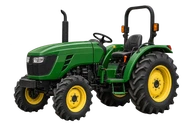

Prepare a John Deere S100 by identifying the machine, checking its controls and condition, then matching the next service or deck job to the correct documents. These six checks help organize that work. The starting sequence, operating restrictions and repair procedures belong to the operator’s manual for the actual tractor and its installed engine.
1. Match the S100 to its engine, deck and manual
Keep a record of the tractor identification number, installed engine model/type/code, deck identification and any replacement-engine invoice. Photograph readable labels before ordering supplies. A hood marked S100 does not identify a replacement engine or a swapped deck.
Deere’s describes a 31R977 (M31) single-cylinder, air-cooled gasoline engine, TLT200 hydrostatic two-wheel drive and a 42-inch Edge side-discharge deck. This describes that published configuration; use the identification on the individual tractor to obtain its applicable documents.
On equipment fitted with Deere’s owner-support QR label, the manufacturer places it on the rear fender to the left of the seat. The linked support record can supply a serial-specific manual and service information. Keep the tractor, engine and deck records together so a supplier can check the whole application.
2. Learn the controls and assess the mowing route
The Canadian configuration uses side-by-side transmission pedals and a yellow manual mower-engagement lever above the dashboard. Locate the brake/parking-brake control and cutting-height lever on the actual machine. A generic instruction to pull an electric PTO switch is inappropriate for this manual-lever arrangement.
Read the manual’s control, starting, stopping and safety-test sections before driving. Have a failed safety check, damaged control or missing guard addressed before use. Testing a seat or brake interlock requires the specified procedure, rather than assuming it works because a switch moves or clicks.
Walk the intended route, remove objects that could be struck and consider people, pets, drop-offs, access and the clipping-discharge path. Assess slopes and attachments against the applicable operating restrictions. Neither engine horsepower nor the nominal 42-inch cutting width establishes a safe route or the mower’s overall clearance.
3. Build an S100 engine-service record
The identifies the following references. Match them to the installed engine and current parts selection before buying.
| Service item | March 2023 S100 reference | Record before ordering |
|---|---|---|
| Engine oil filter | AM125424 | Engine identity and whether a kit already supplies it |
| Inline fuel filter | AM116304 | Current fuel-system application and package quantity |
| Air-filter cartridge | MIU14395 | Actual air-cleaner assembly and element reference |
| Spark plug | M78543 | Engine-specific reference and quantity |
The guide prints 50-hour changes for those engine service items. Use the full applicable schedule for initial service, calendar limits and operating-condition adjustments. Record the date, hours, fluid specification and parts used; a parts table is not an oil-fill or filter-installation procedure.
There is a reason to check a complete kit carefully. The labels LG266 for US use, while the includes S100 as general fit but names MIU13038 as its air cleaner. The dated S100 sheets name MIU14395. Have the current package matched to the engine and air-cleaner assembly before choosing that kit.
Also distinguish a future-service shopping total from the parts needed now. The 2021 sheet’s first-250-hours table prints a two-plug quantity, whereas the Canadian specification describes a single-cylinder engine. Establish the actual engine’s plug requirement instead of copying that table into an order.
Equipment & supplies
Individual S100 oil and fuel filters
These are separate service choices after application confirmation. Check whether an already selected maintenance package includes the same parts.

John Deere AM125424 oil filter
AM125424 is the oil-filter reference in both dated S100 sheets. Match the installed engine and current application before buying it separately from a kit.

AM116304 fuel filter
The Amazon listing describes this AM116304 offer as two filters. Confirm the S100 fuel-system application and buy the pack for the required service or spare supply, rather than treating both as one-service consumption.


As an Amazon Associate I earn from qualifying purchases.
4. Check the actual deck before replacing blades or belts
Use the manual’s shutdown, isolation, access and blade-handling procedure before inspection or measurement. Check the deck identification, guards, discharge equipment and visible condition. Have damaged blades, mountings or unexplained vibration assessed; an arbitrary notch-depth rule or a sharpening tip cannot establish serviceability.
The March 2023 deck sheet lists UC21583 mower blade, AM141033 mulch blade, GX10168 gage wheel and AM130907 leveling gauge. Deere’s includes S100 in its general-fit list and requires equipment selection. Its 134 mm title refers to cut length; the page separately prints a 21.3-inch overall length. Confirm the reference, blade arrangement and seller’s pack quantity rather than buying by one dimension.
For belts, retain the document date: the 2021 sheet lists GX20006 traction and GX20072 mower belt; March 2023 lists UC30568 traction and UC32283 deck belt. These sheets do not supply a serial transition or prove a supersession. Have the current tractor/deck-selected result resolve the order.
Equipment & supplies
S100 deck replacement and measurement choices
A blade and a measuring tool perform different jobs. Confirm the actual deck and follow its instructions for the replacement or measurement required.
John Deere UC21583 mower blade
UC21583 appears in the S100 deck references. Confirm the installed deck, blade requirement and Amazon pack quantity; Deere's minimum order quantity of two does not establish what this seller includes.
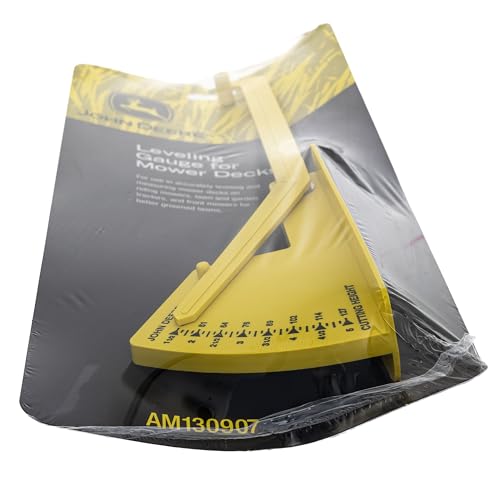
John Deere AM130907 deck-level gauge
The S100 sheets list AM130907 for deck-level measurement. Use the actual deck's preparation, measuring points and adjustment values; a gauge alone does not identify the cause of an uneven cut.

As an Amazon Associate I earn from qualifying purchases.
5. Confirm discharge, collection and attachment equipment
Decide whether the work requires side discharge, mulching or collection, then check the fitted equipment against its instructions. Record the kit references and included hardware. A mulch blade or a used hopper alone does not establish a complete conversion.
For a proposed cart, bagger or other attachment, obtain the tractor and attachment instructions before accepting a seller’s compatibility statement. Compare the complete assembled width and storage space with the intended access. Keep attachment limits and required hardware in the same readiness record rather than applying a generic towing or ballast rule.
6. Record what is ready and what needs attention
Before the session, note hours, visible leaks or damage, unresolved control faults, service due and the intended deck configuration. Use the manual’s prescribed check and preparation methods. The Canadian S100 specification calls the transaxle oil filter nonserviceable, so routine engine-filter advice is not a transaxle-filter replacement instruction.
After use, record new symptoms and perform the prescribed shutdown, cleaning and storage preparation. For a starting or drive problem, give the technician the conditions, hours, maintenance history and observed symptoms. Avoid repeated bypass attempts or replacing a collection of unrelated parts on speculation.
A useful handover note contains the machine identifiers, manual edition, dated service entries, fitted attachments and any work still required. It lets the next operator or service provider see the outstanding decisions without treating a completed checklist as proof that every fault has been resolved.
Followed the ‘Operational Best Practices’ section today and my mowing lap time dropped and edges looked cleaner. The advice about cutting height and overlapping passes really helped. Also:
– Don’t try to scalp wet grass — you’ll just get clumping.
– Keep tyre pressure even; uneven pressure ruins the cutline.
Also loved the storage section; I always forget to put the machine on blocks to stop flat spots.
One odd question: the guide mentions checking belts for frays — what’s the best way to tell if a belt can be patched or must be replaced?
Also check pulleys for wear — sometimes belts wear faster because a pulley is jagged or seized.
If you can see cords or threads, replace. I’ve tried splicing once and it failed a week later — not worth the gamble.
Thanks — good to know. I’ll inspect the pulleys too.
Glad it improved your cut, Noah. About belts: small glazing or light cracking on the surface may still be okay short-term, but any missing chunks, deep cracks through the cords, or frayed edges mean replace it. Belts are cheap; better safe than stranded mid-season.
Love the Attachments & Bagger section. I have the bagger for leaf season and the notes about balance and weight distribution are clutch.
Question: for winterization does everyone drain the fuel or use stabilizer? The guide mentions both but I’m unsure which is safer for a relatively new S100 (2018). Would hate to have gummed carbs in spring.
I always use stabilizer — less work and I’ve had no problems. Pro tip: run the engine for 5 mins after adding the stabilizer so it reaches the carb and injects into the lines.
Good question, Olivia. For a 2018 S100, I usually recommend a fuel stabilizer if you plan to store with fuel in the tank (less hassle). If you expect storage longer than 6 months or have ethanol-blended fuel and want zero risk, drain the tank and carb. Stabilizer + a short run after adding it usually does the trick and is easiest for most owners.
Great step-by-step — I actually used the Pre-Start Inspection list this weekend and it saved me from starting with a flat tire. A couple of notes from my experience:
1) Check the battery terminals for corrosion — mine had a little white crust and the tractor was slow to crank.
2) The guide’s blade-care tip about balancing after sharpen is spot on. I balanced mine with a cheap nail and it made a huge difference in vibration.
3) Small thing: when removing the deck to clean, mark the belt routing with tape before you take it off — saved me a headache later.
Thanks for the clear layout! One question: anyone else noticed the S100 seems to burn more oil after long mowing sessions? Could be age (it’s a 2012 model), but wondering if the Fluids & Filters section should emphasize oil-level checks midseason more.
(Also — nice to see the storage/winterization tips. I winterize differently and would love to compare notes.)
Quick tip: if you do plan to store for winter, put a fuel stabilizer in and run the engine 5 mins so it circulates. Saved my carb last year — otherwise dump the tank like the guide says. 🙂
Thanks for the practical tips, Emma — marking the belt routing is a great pro move! About the oil: older S100s can develop minor seepage around seals, especially if they sit a lot. I usually recommend checking oil after a long mow and watching for a slow rise in consumption; if it’s significant, an inspection of seals/gaskets or an oil pressure check is next. Adding a midseason oil-level checkpoint to the Fluids & Filters section is a good call — I’ll update that.
Yep, had the same with my ’11. Turned out to be a small valve cover gasket seep that only showed up after 2-3 hours of mowing. Took 30 mins to replace and oil stayed stable afterward.
Haha, the ‘Safety First’ section is basically me trying not to lose a finger every spring. Seriously though, the checklist is practical. I did want to add:
– Wear eye protection when scraping grass from the deck — shrapnel is a real thing.
– If you’re using a tow hitch for hauling, remember the max load — don’t be that guy overloading it and then asking why the transmission died.
Also, the blade balancing bit made me feel like a backyard mechanic for 10 minutes. Kinda addicting. 😂
Anyone else tried sharpening blades with a grinder vs file? Which is less likely to mess up the angle?
Grinding here. Use short passes and cool the blade in water occasionally. Keeps the angle and speeds it up. But yeah, if you overdo it the blade weakens.
Also remember to re-balance after any sharpening — a small imbalance = big vibration = unhappy transmission bearings over time.
I use a file — slower but I maintain control. Also less chance of overheating the blade which can ruin the temper.
Grinder is faster but you can easily remove too much material or change the angle; file or a bench grinder with a guide is safer for keeping the right pitch. If you’re new to sharpening, practice on an old blade first.
Lol @ ‘don’t be that guy’ — seen a neighbor do almost exactly that. Ended with a bent hitch and a towbar full of apology. 🤦♂️
Solid guide. Short, clear, and not condescending. I appreciated the mower deck prep pics — made it easy to follow. One tiny gripe: would’ve liked a check-list printable at the end, but that’s just me being lazy 😂
This guide helped me finally figure out how to attach the bagger without swearing. Two constructive things:
1) A quick diagram showing harness points for the bagger would be awesome.
2) For towing tip — put a small cushion on the hitch ball if you’ve got a lighter trailer. The little warning about tongue weight was useful but could use a photo.
Otherwise, great job. The troubleshooting checklist might save someone a trip to the shop.
Thanks, Priya — good suggestions. I’ll add a simple bagger harness diagram and a photo for proper tongue placement in the next revision. Glad the troubleshooting list was useful!
I hit a weird problem after storage last year — tractor cranked but wouldn’t start, smelled like fuel. I followed the troubleshooting steps in the guide: checked spark, cleaned the carb, swapped fuel lines, still nothing. Ended up finding a clogged fuel filter (tiny bit of debris). The guide’s troubleshooting flow helped me narrow it down fast.
Quick question: for the safety pre-start checklist, do you recommend any particular torque spec for the blade bolt? I stripped a nut years ago and refuse to repeat that 🤦♀️
Sorry you had that start-up scare, Grace — fuel filters are sneaky culprits. For blade bolt torque on the S100, most specs are around 60–75 ft-lbs depending on blade style; always check your model’s manual for the exact number. Use a torque wrench if you can — better than guessing.
And if you stripped a nut, maybe try thread locker and a new hardened nut next time.
I don’t have the spec memorized but a torque wrench saved me from over-tightening. If you can’t access the manual, Aim for tight but not full-arm-strength — and definitely new hardware if it’s been rounded.