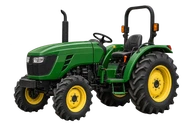

For John Deere S110 maintenance, start with the installed engine and deck, then separate scheduled service from a fault that needs diagnosis. The records below connect the documented filter references, operating controls and deck checks without assuming that every S110 has an unchanged original configuration.
Identify the S110 before making a service list
Record the tractor identification number, engine model/type/code, deck identification and any engine-replacement details. Keep photographs of readable markings and dated service invoices. Obtain the applicable tractor and engine manuals before turning an old parts list into a maintenance procedure.
Deere’s describes a 33R877 (M33) air-cooled single-cylinder gasoline engine, TLT200 hydrostatic two-wheel drive and a 42-inch Edge side-discharge deck. The older identifies 33R877-0104-G1 alongside its spark-plug entry. Neither description identifies an undocumented replacement engine.
The manufacturer’s owner-support QR label, where fitted, is on the rear fender to the left of the seat and links to serial-specific information. Save the manual edition or link with the service record so the person performing the work can check the same instructions.
Plan S110 engine service from the matching schedule
The lists these references and marks the engine service items yearly/every 50 hours. Consult the full applicable schedule for initial service and adjustments to suit operating conditions.
| Item | S110 reference | Purchase check |
|---|---|---|
| Engine oil filter | AM125424 | Confirm installed engine and avoid duplication with a kit |
| Air-filter element | MIU11511 | Match the air-cleaner assembly and element |
| Inline fuel filter | AM116304 | Confirm fuel-system application and seller’s pack count |
| Spark plug | M78543 | Match the engine-specific plug requirement |
| Home maintenance kit | LG262 | Confirm the current package and application |
The Canadian model page describes a conventional replaceable engine oil filter and no-tools oil drain. Use the engine’s specified oil, fill-check method and service procedure. A quantity of oil bottles in a maintenance package is not a fill instruction.
The S110 air reference is MIU11511, rather than the MIU14395 shown in the dated S100 guide. Deere’s includes S110 as general fit and asks for equipment selection. Match the actual assembly before buying; adjacent model numbers do not make their air elements interchangeable.
Keep the purchase list limited to the job. If a confirmed complete LG262 package already supplies a needed filter, buying the same loose filter adds a duplicate. No verified Amazon LG262 offer is included here; the following are individual part choices.
Equipment & supplies
Individual filters for a confirmed S110 service job
Check the installed engine, current references and package quantities. These offers identify separate parts, not a complete service procedure.

John Deere AM125424 oil filter
AM125424 is listed in the S110 engine sheets. Select it separately when the confirmed engine service calls for this reference and a maintenance kit does not already supply it.
John Deere MIU11511 air-filter cartridge
This MIU11511 offer matches the S110 reference in Deere's March 2023 guide. Check the installed air-cleaner assembly; it is not the MIU14395 element shown for S100.

AM116304 fuel filter
AM116304 is the documented S110 fuel-filter reference. The Amazon listing describes two filters in this offer, so distinguish the pack count from the quantity needed for the present service.


As an Amazon Associate I earn from qualifying purchases.
Check the actual controls before an operating handover
The Canadian S110 configuration has a yellow manual mower-engagement lever above the dashboard, side-by-side drive pedals and a spring-assisted cutting-height lever. Locate these controls on the individual tractor. Instructions for an electric PTO switch or a preset-height pin do not describe that arrangement.
Read the applicable starting, stopping, parking and safety-test procedures before operation. Use the specified interlock tests; a switch that moves or clicks is not proof that its safety function works. Have missing guards, damaged controls or failed tests addressed before use.
The published engine is air-cooled, and the transaxle specification labels its oil filter nonserviceable. Generic advice to inspect coolant or change a hydrostatic filter is therefore unsuitable as a routine task list for this configuration. A drive complaint needs an actual diagnosis and the applicable service information.
Separate deck setup from a blade or belt order
Identify the deck and intended discharge, mulch or collection setup. Follow its instructions for safe access, cleaning, blade handling and fastener torque. Have damage or unexplained vibration assessed before operating; this page does not provide a blade-rejection depth or an underside-support procedure.
March 2023 lists UC21583 mower blade, AM141033 mulch blade, GX10168 gage wheel and AM130907 leveling gauge. The undated reminder instead lists GX22151 blade. Deere’s explicitly names UC21583 as a substitute, while the includes S110 as general fit. Confirm the deck-selected current result and seller’s quantity before ordering. Neither a blade nor a broad fit list establishes all hardware needed for a mulch conversion.
The older sheet lists GX20006 traction and GX20072 mower belts; March 2023 names UC30568 traction and UC32283 deck belt. The March 2023 S100 and S110 sheets even print different dimensions for UC32283. Resolve the current belt through the actual tractor/deck identification rather than choosing one of those printed lengths or assuming a documented serial split.
Equipment & supplies
A measuring tool for S110 deck checks
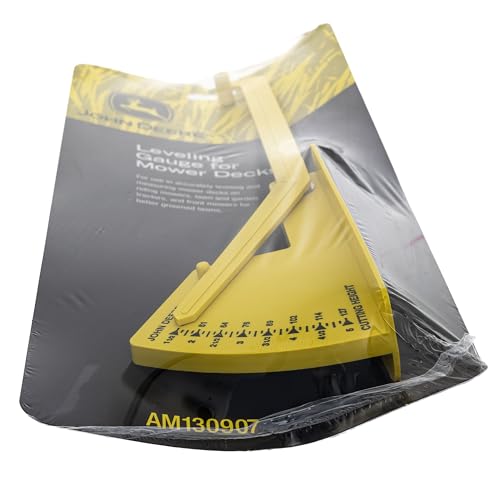
Confirm the measurement procedure and settings for the fitted deck before using the gauge.
John Deere AM130907 deck-level gauge
AM130907 is listed on the S110 deck sheets. Use the manual's preparation, measuring points and adjustment sequence; the tool does not diagnose every cause of an uneven cut.
As an Amazon Associate I earn from qualifying purchases.
Record a fault before choosing replacement parts
| Observation | Information worth recording |
|---|---|
| Starting complaint | Whether it cranks, conditions when it occurs, engine identity and recent work |
| Uneven cut or vibration | Actual deck, blade reference, visible condition and when the symptom began |
| Drive complaint | Operating conditions, hours, service history and the behavior observed |
| Fuel or oil leak | Visible location and circumstances, without approaching a running mechanism |
Use that record to request the appropriate inspection or repair. A filter purchase does not resolve every starting, cutting or drive symptom. Follow the prescribed shutdown and isolation before any inspection, and keep unresolved faults out of the ready-for-use list.
Close the service record and prepare for the next session
Record the date, hours, parts, fluid specification, work completed and items still outstanding. Keep receipts and the current references used for any substitution. This is especially useful when a used mower arrives with incomplete records or a different engine or deck.
For cleaning and seasonal storage, follow the applicable instructions for the engine, fuel system, battery and deck. Choose any charger only after checking the battery and its charging requirements. Avoid a fixed stabilizer running time or a generic battery-storage rule copied from another mower.
Before returning the S110 to work, verify that required maintenance, safety checks and fault repairs have been completed through the specified procedures. Keep the manual and service record accessible for the next operator rather than relying on a verbal assurance that the machine was recently serviced.
Heads up — if your mower hesitates under load after a while, check the air filter and fuel filter first. Had the symptoms and it was a clogged air filter. Cleaned it and back to smooth mowing.
Also, the guide’s diagram for control locations helped my cousin when he borrowed the tractor. He returned it in one piece, so thanks 😂
Amen. Filters are the unsung heroes of mower life.
Great troubleshooting pointer, Victor. Air and fuel filters are common culprits for load-related hesitation — we emphasized them but always good to repeat.
Followed the mower deck leveling steps; still getting an uneven cut on steep spots. Anyone else? Might be the deck hangers or worn spindle bearings? 🤔
Could be spindle bearings for sure. Lift the deck and spin each blade by hand — if it feels rough, time to replace bearings.
Short and useful. The safety check section saved me time.
Loved the beginner-friendly language. One question: For winter storage in colder climates, do you recommend removing battery or leaving it on a trickle charger? I worry about freezing but also about losing settings.
Good question. For cold climates: remove the battery and store it in a cool, dry place on a trickle or maintenance charger. Leaving it on the machine can lead to draining and potential damage in very cold temps.
I keep mine on a smart charger in the garage and it’s been fine for years.
Honestly, this guide made me feel like a lawn tractor whisperer.
I followed the starting-up checklist this morning (cold start) and the tips about choke and throttle timing were spot on. The first crank and it fired right up. No drama.
Also loved the troubleshooting flowchart — saved me 30 minutes of random button pressing. The seasonal storage part is super helpful too; I never knew to fog the carbs if storing for the winter.
10/10 would recommend to my neighbor who’s been afraid of tractors since childhood.
Good tip on stabilizer — I use it and haven’t had gum in the carb since.
If anyone wants a quick checklist card to print and tape on the tractor, I can post a simplified version.
Neighbor here: I was afraid too until I realized it’s basically a big ATV with a grass fetish. 😅
So glad it worked for you, Lily. Fogging the carb or adding stabilizer are both good options for longer storage—stabilizer is less messy for most people.
You brave soul. I still call my dad to start mine sometimes 😂
Thanks for the seasonal storage tips. I used the fogging method this year and had zero starting issues in spring. Worth the extra minute.
Awesome — glad fogging worked for you. It’s an easy step that pays off.
This is the most user-friendly manual-style guide I’ve seen in ages. Loved how you explained controls slowly for new users.
My only nitpick: maybe add a short section on what to do if the mower won’t engage the blades but engine is running — I had that happen and it was clutch-related.
Yeah, even a 3-bullet quick guide would help newbies.
Clutch issues were my nightmare last season — having a quick checklist would have spared me a tow to the shop.
Thanks, Hannah. Good call — the deck engagement troubleshooting is in the longer troubleshooting section but I can add a quick checklist near the controls section.
Couple of practical things I wish were emphasized earlier:
– Always wear eye protection when changing blades.
– Mark the belt routing with tape before removing it so you don’t forget.
– Clean grass out of pulleys monthly.
These little habits saved me time and headaches.
Eye protection is underrated — I had a pebble fly up once, never again.
Also add gloves for handling blades, they get sharp fast.
Totally agree about tape on the belt routing. Saved me a rebuild once.
Great additions, Robert. I’ll add those as quick daily/weekly habits in the maintenance checklist — very practical.
Tip from my experience: after dethatching heavy wet grass, raise the deck and run the blades a bit to clear clumps before storing. Helps prevent rust and balance issues.
Also, anyone tried switching to stainless blades on the S110? Curious about longevity vs. cost.
Stainless saved me one season after I left blades on a wet porch by mistake. Not a miracle solution but helpful.
Make sure any aftermarket blades are balanced — unbalanced blades can ruin spindle bearings fast.
I’ll add a short note about blade materials and balancing to the blade care section.
I used stainless on an old mower near the coast — they lasted longer but were pricier. If you keep blades dry after use, regular ones do fine.
Solid tip on clearing clumps. Stainless blades are less common and more expensive; they resist rust but may not hold an edge longer than high-quality carbon blades depending on use. Worth it if you mow salty or coastal areas.
Nice walkthrough. The fuel and oil section was concise — I like that you reminded folks not to mix gas with oil unless it’s a 2-stroke (duh, but people still do it). Saved me from writing a long plea 😅
Totally — I once put the wrong oil in my push mower and it smoked for a week. Learned my lesson hard way 😂
Ha — true! We tried to keep it practical. For the S110, fresh unleaded and the right SAE oil are all you need. Cheers!
Loved the troubleshooting flow. I had a carb drip issue last month and followed the steps — pinpointed a faulty float needle. Saved me a new carb purchase.
Minor quibble: maybe add links to OEM part numbers for common replaceables (filters, blades, belts) to make shopping easier.
Yes please for parts list — saved me hours of guessing.
Good suggestion. I’ll consider adding a parts reference table with OEM numbers in the appendix. Glad the flow helped you locate the float needle!
That would be clutch — shopping sites sometimes have wrong fitment info.
Appreciate the oil change intervals and step-by-step on draining. One constructive note: it would be great if the guide included torque specs for the blade bolts and lug nuts (if applicable). I had to search elsewhere and hate mixing manuals mid-job.
Otherwise, nice work — especially the pics of blade orientation.
Good point, Priya. Torque specs are important. For the S110 blade bolts we list: 30–40 ft-lbs (double-check your model plate/manual). I’ll add a callout in the next update — thanks!
I’ll also add a tip about threadlocker vs. new hardware when replacing corroded bolts.
Thanks for flagging that — I always forget to torque properly and then worry the blade will go flying.
Yep — bolts snug but not Hulk-tight. Using a torque wrench saved me from rounded heads.
Great guide — super thorough!
I really appreciated the step-by-step on the mower deck setup. I was always nervous about leveling the deck and you made it feel doable.
One question: you recommend checking belt tension after the first few hours. Any tips on how tight is too tight? My last ride-on felt like the belt was strangling the engine 😂
Also the safety checklist at the start is gold. Saved me from mowing over a garden gnome last weekend. 😅
Thanks, Sarah — glad it helped! For belt tension: aim for a little give when you press the belt midway between pulleys, about 1/2 inch of deflection is common. If it feels rock-solid with no give, that’s probably too tight and can wear bearings.
I had a belt too tight once and heard a weird whine. Loosened it per the manual and the noise went away. 1/2″ sounds about right.
Also check pulley bearings for play — a tight belt can hide a bad pulley, but the bearing will fail eventually if stressed.
Quick note: the part about checking tire pressure should include typical PSI numbers for the S110. I fluffed them up by accident and the cut was wavy. Learned to recheck and it helped.