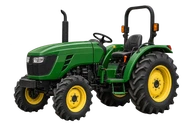
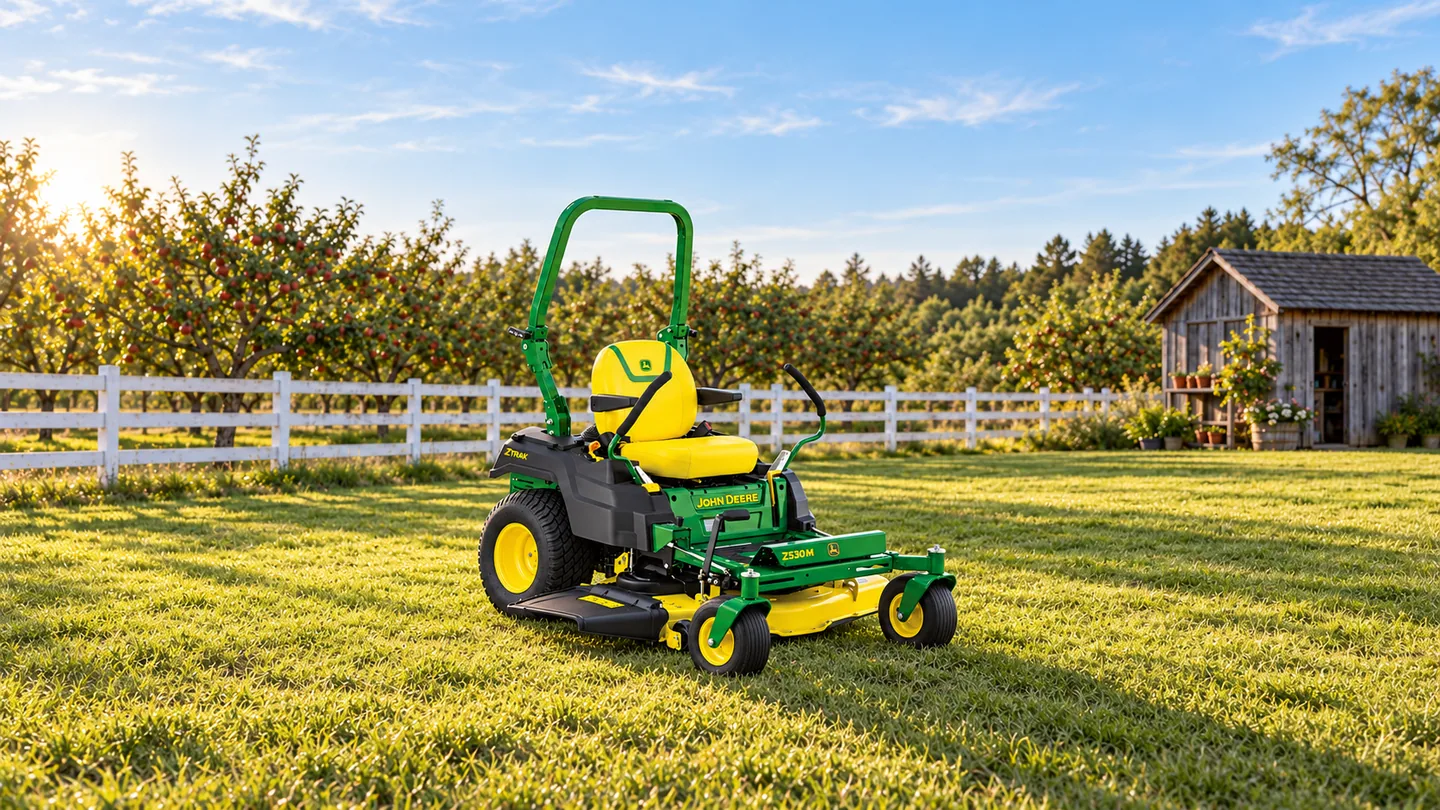
Choose lawn-care tools by the problem you can identify: an uneven cut, compacted soil, a measured thatch layer or a nutrient need. A mower, aerator, dethatcher and spreader do different jobs. Buying them together does not establish that the lawn needs every treatment or that every attachment works with the mower you own.
Match the symptom to a check before shopping
| What you notice | Check first | Tool decision |
|---|---|---|
| Uneven mowing | Mower setup and deck condition using its manual | Correct the setup before choosing a replacement machine |
| Hard, compacted ground | Soil condition and whether grass is actively growing | Consider core aeration when compaction is the issue |
| A dense layer between soil and green grass | Examine and measure an actual turf sample | Decide whether thatch management is needed |
| Weak growth or a nutrient concern | Laboratory soil report and local grass-care advice | Choose an amendment and delivery tool only after the recommendation |
| Too much work for an occasional task | Frequency, access, storage and rental availability | Compare renting or hiring the task with owning its equipment |
Keep the play area, garden edges and runoff-sensitive areas on the plan. An attractive lawn does not establish a particular increase in property value. Choose a treatment for its observed need rather than a promised financial or environmental outcome.
Check the mower you have before choosing another one
Record the mower model, PIN and installed deck. Use the applicable manual to check mowing setup, tire pressure, deck adjustment and the condition of the cutting equipment. A used RX-series machine and an X-series tractor need their own documentation; a series name does not supply a common adjustment procedure.
When comparing a lawn tractor with a zero-turn, include gates, turning space, storage and the slope limits of the specific candidates. Deere’s U.S. residential guidance says individual machines have different slope operating limits and some areas are unsuitable for riding mowers. Do not choose solely by advertised speed or deck width. .
For a robotic mower, verify current U.S. availability, the exact model’s boundary and charging requirements, terrain limits and local service. Do not assume smartphone features or operating conditions from another model. If the existing mower can do the required job with a documented setup change, compare that option before replacing it.
Tools for lawn measurements and mower setup

Komelon SL2825 25-foot tape measure
Record a gate opening, storage clearance or a small lawn section before comparing equipment. A measured dimension does not establish hitch compatibility or permission to tow.

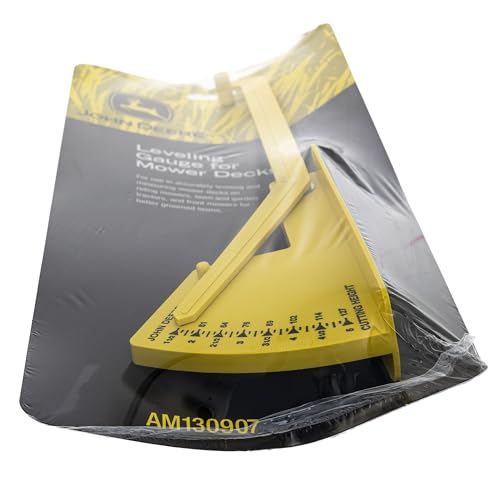
John Deere AM130907 deck-level gauge
Compare this gauge with the measuring tool and procedure specified for your mower deck. Use the applicable manual's setup and adjustment values; the gauge does not supply a universal cutting-height setting.

As an Amazon Associate I earn from qualifying purchases.
Separate soil compaction from thatch
A core aerator removes plugs of soil; a spike tool that only presses holes does not perform the same operation. Maryland Extension advises core aeration for compaction and notes that aeration alone cannot solve soil saturation. Persistent wetness needs investigation before another mechanical treatment. .
Thatch is the interwoven plant material between green vegetation and the soil, not simply loose clippings on top. Examine a turf sample before choosing removal equipment. Minnesota Extension uses a layer over one-half inch as a trigger to consider thatch management in its lawn guidance. That is a diagnostic reference, not a command to dethatch every lawn. .
Plan aeration or dethatching while the grass can recover. Maryland Extension distinguishes early-autumn work for Kentucky bluegrass from late-spring or early-summer dethatching for zoysia. Use local guidance for the grass and climate at your property; a northern calendar is not a nationwide schedule. For infrequent work, ask about rental or a contractor before buying a tow-behind attachment.
Establish the nutrient need before choosing the spreader
A laboratory soil test can identify pH and nutrient conditions and provide recommendations for amendments. Follow the lab’s sampling instructions and the regional advice for your grass. A moisture reading does not replace a nutrient or pH test. .
A drop spreader places material below the machine; a broadcast spreader distributes it across a wider swath. Choose for the area, boundaries and material, then use the product label and the spreader’s calibration instructions. A hopper capacity is a storage quantity, not an application rate. .
For a liquid product, confirm that the sprayer equipment and product label permit the intended use. Follow the label’s application and protection requirements and local rules. Do not infer chemical-splash protection from general workshop eyewear, or tow approval from the presence of a hitch. Grass type, growth season and local recommendations determine timing; there is no single spring-and-fall schedule for every U.S. lawn.
Confirm the complete attachment combination
Before ordering a bagger, mulching kit, aerator or spreader, record the exact attachment reference and check the mower model, deck, PIN range and required mounts, ballast or other components. Deere’s dated 2024 attachment charts separate tractor and zero-turn models and deck combinations. A collection-system component is not necessarily a complete collection system. .
A catalog match is a starting point for checking the actual installation, not permission to combine any tasks at once. Follow the machine, attachment and material instructions together. Ask the supplier to resolve a missing requirement before ordering.
Hearing protection for a noisy mowing task

3M Pro-Grade earmuffs
Compare these passive earmuffs with the protection needed for the task and check their fit. The listing identifies an NRR of 30 dB; that rating is not a guarantee of the reduction achieved by every wearer.

As an Amazon Associate I earn from qualifying purchases.
Choose one justified next task
Record the observed problem, the check that supports it, the treatment’s timing and the equipment needed. Then confirm access, compatibility and storage, or obtain a rental or contractor quote. Recheck the result before adding another treatment. A tool earns its place by solving a defined job; it does not need to be part of a full set.
This article was super helpful! I just bought my first John Deere mower, and I feel like I’m finally getting the hang of lawn care. 😁 The tips on aerators made me realize I’ve been neglecting that part for way too long! Anyone here have advice on fertilizing schedules?
Glad you found it helpful, Sarah! Fertilizing depends a lot on your grass type and climate, but typically 2-4 times a year is a good start.
Congrats on the mower, Sarah! 🎉 I’ve found that fertilizing in early spring and fall works wonders. Just make sure to check your local lawn care schedule too!
I’m gonna be honest—I was skeptical about aerators. They seem like a lot of work! But after reading this, I might just give it a shot. 🤞 Do they really make that much difference?
Aerating helps with drainage and nutrient absorption, so it usually pays off in the long run.
Absolutely! I was surprised at how much my lawn perked up after using one. It’s worth it if you want that lush look!
I love my John Deere mower! 💚 Mowing has never been more fun, and my grass has never looked greener. Can’t wait to try some of these other tools mentioned! Anyone tried the aerator?
Yes! I just got one and it’s a game changer. The yard looks so much healthier now.
So glad to hear that, Jessica! The aerator can definitely take your lawn to the next level!
Hmmm… I don’t know, I feel like this article is just selling John Deere stuff. I mean, they’re great tools and all, but what about budget options? 🤔 Would love to hear about those too!
Totally get you. We shouldn’t always need to go top-of-the-line! What do you currently use?
Thanks for your input, Liam! We wanted to highlight our favorite tools, but we can look into budget-friendly options in future articles!
Cool article! Just a little long-winded for me. 😂 I mostly skimmed through the sections, but the mower tips are great! Are these just applicable for residential lawns or can they work for larger properties too?
Good question, Olivia! Most of our recommendations can be adapted for large properties as well, depending on your specific needs.
Definitely applies to larger properties! Just adjust the size of the tools you’re using.
Whoa, I didn’t even know some of these tools existed! Like, Innovative Turf Tools? Sounds fancy! 😂 Anyone tried those yet? Are they worth the hype?
Haha, right? I just bought a dethatcher last week from John Deere. Definitely made a difference! 🙌
The innovative tools offer a lot of unique features, but it really depends on your lawn’s needs.
Man, I love the innovation in lawn care! Who knew gardening tools could be so advanced? You should see what I did with my yard last summer—total makeover! 🌼 Just need the right tools to keep it up! Anyone have recommendations?
Thanks for sharing, Megan! Happy gardening, Brian! Don’t forget about regular maintenance for that makeover.
Sounds awesome, Brian! Garden makesovers are so satisfying! I recommend the John Deere fertilizing spreader, worked wonders for my flowers.