A John Deere skid steer enquiry should start with the job, the exact model and its installed equipment. Separate wheeled skid steers from compact track loaders before comparing capacity, attachments or used prices. A higher horsepower figure alone does not answer whether a machine can handle the intended load, reach the unloading point or use a particular attachment.
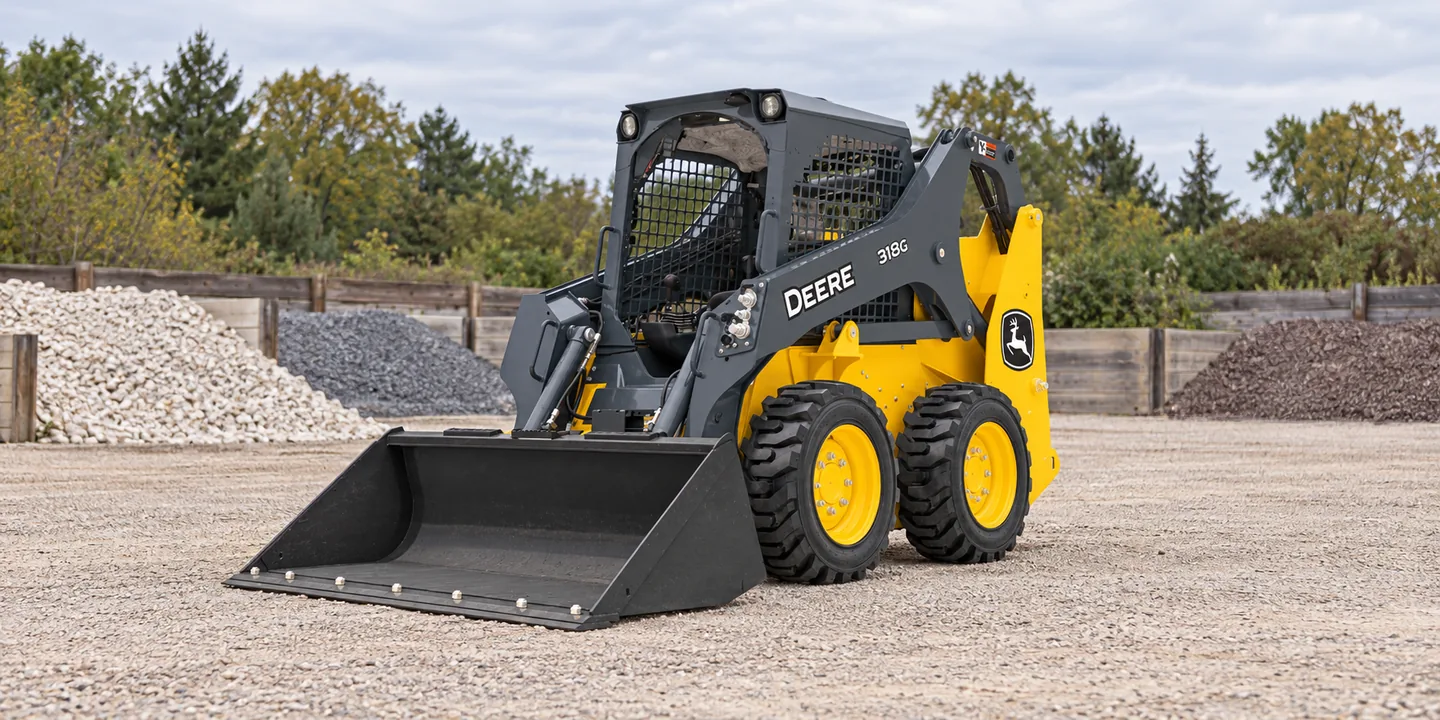
The parked 318G illustration is a contextual example. It does not document a machine inspection, attachment compatibility, fuel consumption or work completed.
Identify the model before comparing machines
Request a readable product identification number (PIN) plate, the complete model designation and photographs of the actual machine. Match those details to its operator’s manual and specification document. A listing headline or replacement decal is not enough to resolve an uncertain identity.
John Deere’s distinguishes the wheeled 316GR and 318G skid steers from the 317G compact track loader (CTL). These are named legacy examples, not a complete current model range or a statement of local availability.
| Candidate information | What it resolves | What still needs checking |
|---|---|---|
| Model and PIN | Which machine’s documents to obtain | Installed options, modifications and service history |
| Wheels or tracks | Skid steer versus CTL category | Suitability for the actual surface, access and work |
| Attachment model and identification | Which attachment instructions to obtain | Coupler, hydraulic and control requirements for the pair |
Do not select wheels or tracks from a blanket claim about traction or turf damage. Describe the surface, soft areas, turning space and site restrictions to the supplier. Ask for an assessment of the proposed machine in those conditions; this guide does not establish a safe slope limit or permission to cross weak ground.
Describe the work, access and transport requirements
Give the supplier a short job record: material to be handled, expected load, loading height, required reach and the attachment involved. Include the narrowest opening and any overhead restriction. Ask for dimensions of the proposed configuration, including its tires or tracks and attachment, rather than assuming every machine with the same model badge has the same working envelope.
Keep transport as a separate check. Obtain the configured machine’s transport weight, the attachment and other carried equipment weights, and the loading and securing instructions. Have the proposed vehicle and trailer combination assessed against its actual ratings and applicable requirements. A brochure operating weight alone does not approve a towing arrangement.
For repeated work, ask whether the seller can arrange a supervised demonstration of the intended application under the machine and attachment instructions. Define the task beforehand. Do not treat an unrelated loading video or an advertised fuel-saving percentage as evidence of your own output or operating cost.
Compare lift geometry and capacity on the same basis
The G-Series brochure contrasts radial lift’s mid-height reach with vertical lift’s reach higher in the lift path. Compare the actual loading height and reach, rather than treating either design as universally better.
Capacity labels also need their basis. In that brochure, the 318G table lists a rated operating capacity of 1,945 lb and 2,095 lb with counterweight. The 317G CTL table separately lists ratings at 35% and 50% of tipping load. Those entries are not interchangeable shopping numbers. This is an example of how to read the document, not a load authorization for a machine being offered.
Ask the supplier to identify the applicable rating, counterweight, attachment and operating conditions for the exact unit. Tipping load, rated operating capacity and breakout force describe different things. Do not substitute one for another or calculate an operating limit from the engine’s horsepower.
Check the attachment as an identified machine–tool pair
A matching brand name or a similar-looking mounting plate does not establish a complete working combination. Obtain the attachment’s model and instructions, then compare them with the machine’s installed equipment. Have unresolved requirements confirmed before ordering either item.
John Deere’s provides attachment-specific compatibility tables and hydraulic requirements. Its CP-series cold-planer table, for example, specifies high-flow machines and lists hydraulic, case-drain and electrical connections. That requirement must not be transferred to every attachment or assumed present on every skid steer.
| Requirement to resolve | Evidence to request |
|---|---|
| Mechanical interface | Actual coupler type and attachment mounting requirements |
| Hydraulic supply | Required flow and pressure, compared with the installed machine circuit |
| Return or case-drain connection | The attachment’s requirement and the machine’s provision, where required |
| Electrical controls | Required connector, controls and installed equipment |
| Capacity and application | Attachment weight, intended material and the machine manufacturer’s applicable limits |
Leave a requirement marked unresolved if the listing does not answer it. Do not use the page illustration as proof that the depicted machine has a particular auxiliary circuit, coupler or attachment approval.
Treat cab features and used condition as separate checks
Ask which controls, camera, lighting, cab and hydraulic options are physically installed and functioning. The labels several features as optional, including a rear-view camera and switchable ISO-H electrohydraulic controls. This regional example explains why a family-level feature description cannot confirm the equipment on a US listing. It is not a substitute for that unit’s build information.
For a used candidate, request service records, repair details, recorded hours and any unresolved faults. Have a qualified inspector assess the relevant structure, lift-arm joints, hydraulics, running gear and safety systems using the exact machine’s requirements. Photographs can support an enquiry; they cannot clear a crack, leak, damaged restraint or modified structure for service.
John Deere’s identifies inspection areas including the cab structure, seat belt, brakes, shutoff circuits, hydraulics and wear items. Its list covers multiple equipment types. Ask which checks and program terms apply to the specific unit; a normal used listing is not automatically certified.
Arrange any operating demonstration through a qualified operator and the applicable manuals. Do not bypass an interlock, test under raised equipment or improvise a hydraulic test to finish a purchase inspection. If identity, condition or safety remains unresolved, postpone the purchase decision rather than treating the seller’s assurance as an inspection result.
Compare written new and used offers
Request a quote for the identified machine and configuration. Record the included bucket or other attachment, options, delivery, tax treatment, required work and any excluded items. Separate confirmed figures from estimates; there is no universal purchase price, repair allowance or fuel-saving figure for this category.
| Offer detail | Question for the seller |
|---|---|
| Machine and equipment | Which PIN, installed options and attachments does this quote cover? |
| Used condition | Which inspection findings and repairs are documented, and what remains unresolved? |
| Warranty or service plan | What written coverage, exclusions, time/hour limits and transfer conditions apply to this unit? |
| Local support | Who will service it, what work can they provide, and what availability or lead time is confirmed now? |
Compare the documents before comparing headline prices. Do not assume a fixed warranty period, parts delivery time or on-site service merely because another owner received it. Ask the local provider for the actual terms and availability.
Send a useful skid steer enquiry
Send the model or listing, PIN if available, job record, site constraints and proposed attachment to the supplier. Request the matching machine documents, installed-option details, attachment requirements and a written offer. For used equipment, add service history and a qualified inspection request.
The next decision is whether the evidence supports that particular machine for the stated work. If the supplier cannot resolve a configuration, condition or application question, keep it open and seek a documented answer before committing.
So, about this efficiency thing… Is it really worth it? I mean, these machines aren’t cheap. Just wondering if the savings on fuel and time actually make up for the upfront costs. 🤔 Has anyone calculated the ROI after a year or two?
That’s a solid question! I looked at the numbers when I bought mine, and I’ve definitely seen savings. If you’re using them often, it pays off!
ROI can definitely vary based on usage, but many customers report considerable savings over time.
I was skeptical too, but I’ve been tracking my fuel costs and the efficiency has really helped!
Anyone else have a favorite feature from the new tech? Personally, I think the integrated camera system is a game changer! It seriously improves visibility when you’re operating in tight spots. The engineering team really outdid themselves. Kudos to John Deere for staying ahead of the curve! 🙌
Definitely! That camera system saves me a ton of stress on the job site. I was a bit worried it might be gimmicky, but it’s actually super useful! 🙏
Glad to hear you’re enjoying it, Nick! Feedback like this helps inform future designs.
Wow, this article just makes me want to jump on a skid steer and start working! 😄 I always knew John Deere had a reputation, but reading about the engineering legacy and durability really puts it into perspective. I can’t believe how much technology is packed into these machines. Anyone here had a chance to test one of the new models? Would love to hear about your experiences!
Thanks for sharing, Devon! The new models really are impressive with their tech upgrades!
I tried the new compact model last month, and I was blown away by how easy it was to maneuver! Honestly felt like driving a video game. 🎮
Still think the old models had more charm, tbh. There’s just something about the feel of a classic machine, ya know? 🚜 But I can appreciate the improvements in customer support and service. They seem to be on the ball. Has anyone else felt a difference with their support?
I’m with you, Jack. There’s just something nostalgic about the older models.
OMG yes! I had a minor issue with my last skid steer, and they responded super quick! Really impressed with the service.
It’s great to hear that quality support! That’s a huge part of the John Deere experience.
Nice overview, but I felt like parts of it were a bit too technical for someone who’s just getting into this stuff. 😅 The efficiency part was interesting, but maybe a few more practical examples would help? I think I lost track a few times. You know, like how it translates to real work on a site.
Totally get where you’re coming from, Mike! Sometimes it’s hard when articles assume you know all the lingo. Maybe we can start a glossary for newbies? 😜
That’s a great suggestion, Emily! We’ll consider adding more practical examples in future articles.