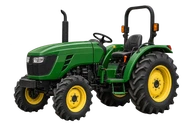
Build a landscaping tool list from the tasks on the property: mowing, collecting clippings, finishing edges, moving material or working soil. Those jobs call for different equipment. A mower’s model name does not establish that it can carry a loader, backhoe or powered soil implement.
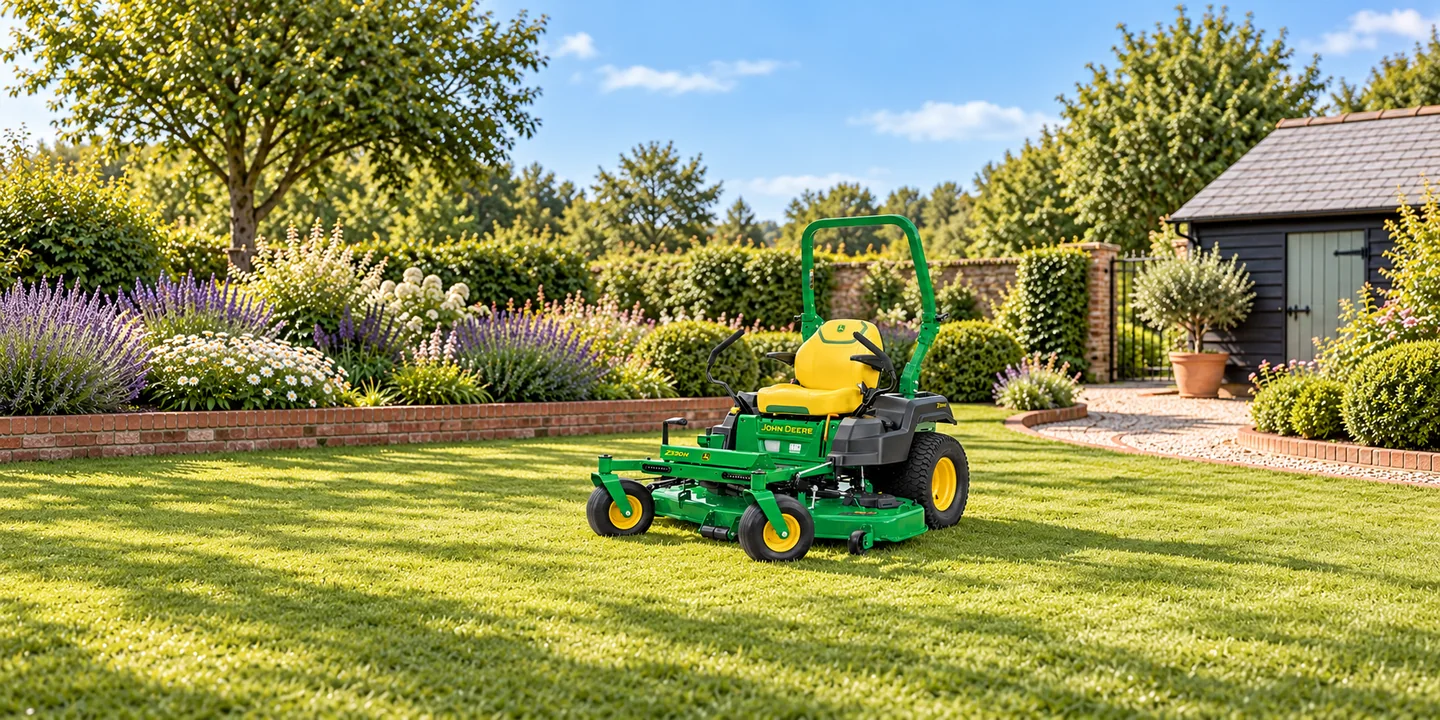
The Z530M shown with this guide represents the mowing stage. The workshop tools below are separate products from their named manufacturers, not John Deere attachments or a package required for every lawn.
Choose the equipment category by task
| Task | Equipment category to investigate | Information needed first |
|---|---|---|
| Cut maintained lawn | Lawn tractor or zero-turn mower | Route, access, clipping plan and model-specific operating limits |
| Collect clippings | A supported collection system | Actual deck, chute or blower requirements and emptying access |
| Finish grass beside obstacles | A separately identified trimming or edging tool | Work surface, reach, protection requirements and tool instructions |
| Move loose material | An appropriately equipped tractor and loader | Tractor-loader-attachment match and the documented load configuration |
| Work or excavate soil | A compatible implement or backhoe arrangement | Exact interfaces, machine requirements and the relevant operating documentation |
Choose only the categories needed for the work. A lawn that needs mowing and edge finishing does not automatically need a compact tractor. For mowing feature comparisons, use the John Deere mower innovations guide.
Plan mowing and clipping handling together
Deere identifies the as a zero-turn mower. Its Canadian feature page lists Power Flow collection for the 48A and 54A decks, but not the 60A deck. Check the actual deck and market before turning a collection plan into a parts order.
Decide where collected material will go and whether the fitted equipment can reach that location. If clippings will remain on the lawn, confirm the mowing mode and components required by the exact deck. Do not use a photograph of a collector or a model-family description as proof of fitment.
A mowing route also needs its own operating check. Follow the machine manual for terrain, slopes, water edges and attachment restrictions. Maneuverability does not establish that a route is safe.
Measuring and protection before the work
Select protection for the actual task and exposure, using the equipment instructions and the product’s markings. These general supplies do not determine whether a site is safe to mow.

Komelon SL2825 route tape:
Record gates and storage openings before comparing the complete equipment dimensions. Keep the measurements with the route sketch rather than choosing by cutting width alone.

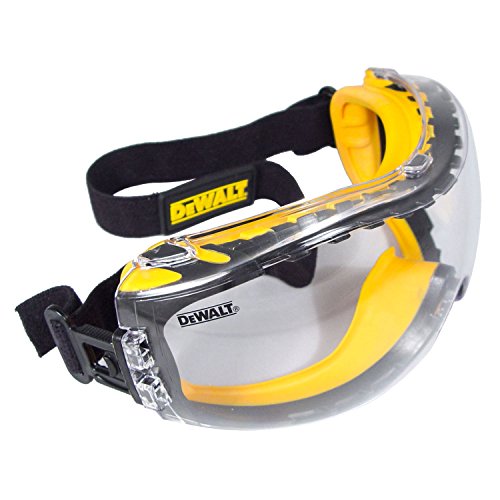
DEWALT DPG82-11 clear goggles:
Adjustable goggles for a task that calls for suitable eye protection. Check the required rating and fit; this listing does not establish chemical or splash protection.

3M Pro-Grade earmuffs:
Adjustable hearing protection to evaluate against the work's noise exposure and required fit. A package rating is not a promise of the attenuation achieved by every wearer.


As an Amazon Associate I earn from qualifying purchases.
Keep loader and backhoe choices separate
A front loader and a backhoe have different attachment arrangements. Deere’s describes tractor subframe support and a required power-beyond hydraulic system. It does not describe a backhoe attached to a loader bucket.
For material handling, have the dealer identify the tractor, loader, attachment and required operating configuration together. Do not infer a permissible load from bucket size, a photograph or an unrelated tractor’s specification. This guide supplies no load rating or installation procedure.
Confirm soil-work interfaces before selecting an implement
Write down the job before shopping: surface preparation, cultivating an existing bed and excavation are different requirements. A named implement is useful only when its application and connection to the available machine are established.
Have the supplier verify the exact tractor and implement combination, including the hitch, drive or hydraulic requirements specified for it. There is no tiller or backhoe fitment claim in the general tool cards below. Ground-disturbing operations and attachment installation require their own site assessment and operating instructions; this page is not a digging procedure.
Use a separate plan for edges and narrow spaces
Mark places the mower cannot cover within its operating limits. Then decide whether the remaining job is grass trimming beside an obstacle or defining an edge along a surface. Identify the actual tool and its instructions before choosing cutting accessories or protection.
Follow the tool’s instructions for bystanders and the work area. A riding mower specification does not establish the capabilities of an edger or trimmer. No handheld tool is attributed to John Deere here without a verified model source.
Keep a record of the work and service needs
Record the equipment used, the work completed and any condition that needs attention before the next session. For the Z530M, Deere provides an with links to manuals and maintenance resources. Select the documentation for the actual machine and serial range.
Inspect or service equipment only after the shutdown and securing steps in its manual. The tools below support accessible inspection and specified lubrication; they do not replace a service procedure.
Inspection tools for the service record
Ullman HTC2 inspection mirror:
Look at an accessible label or fitting from a different angle and record what needs attention. It does not justify reaching into moving equipment or beneath an unsupported attachment.

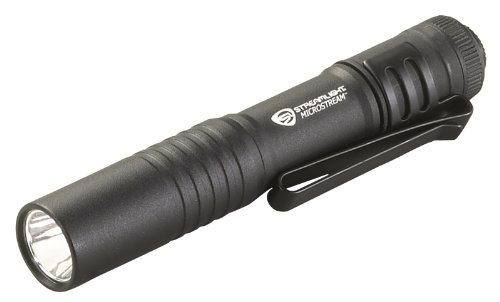
Streamlight 66318 label light:
Illuminate identification and service labels on a secured machine. Match the recorded number to the correct documentation instead of identifying a part by appearance alone.

LUMAX LX1152 grease gun:
A pistol-style gun with a flexible hose for lubrication points specified in the machine manual. Confirm the prescribed grease, fitting and procedure first; not every component has a grease point.


As an Amazon Associate I earn from qualifying purchases.
Build the next work session from the checks
- List the actual tasks and mark the route, access restrictions and places needing a separate tool.
- Identify the machine, deck and each proposed implement; resolve undocumented compatibility before ordering.
- Read the applicable operating instructions and choose task-appropriate protection.
- Complete only work within the equipment’s documented limits, then record service needs before the next session.
The useful tool list is the one attached to those tasks and checks. General workshop supplies can support the work, while machine attachments still need their own verified application.
You guys raved about the tractors but what about the tillers? I’m considering one, but what’s the learning curve like? I’ve never used one before. Anyone willing to share their experience?
Honestly, John, it’s not too hard to get the hang of, especially the new models. Just watch some tutorial videos if you need guidance!
Thanks for chipping in, Lisa! Tillers are quite straightforward; just take it slow at first, and you’ll be fine!
I found this article pretty helpful, but I wish there was more about smart technology. I know it’s a thing now, but how does it REALLY help? Are the smart features just gimmicks or do they actually save time? 🤔
Great point, Gary! Smart technology can enhance productivity by allowing remote operation and monitoring. It’s worth considering if you’re investing in new tools.
They actually save a TON of time! I use the auto cut feature and it’s great for those busy weekends. Definitely worth looking into!
I’m not gonna lie, I clicked on the article thinking it wouldn’t be that interesting. But y’all, the section on mowers really sold me! I keep just pushing my old one around. Any recommendations for a beginner-friendly model? 😅
My buddy has one and swears by it. It’s pretty lightweight, too, which is a plus!
Definitely go for the John Deere X350. Super easy to use and you can get a lot done without breaking a sweat!
Happy to hear that, Sarah! The X350 is indeed a great choice for beginners. You’ll love it!
Man, this article made my day. Just sold my old equipment and ready to upgrade. 😄 Wasn’t sure about going with John Deere, but the loaders sound amazing! Anyone got any preferences on attachments? I need versatility for landscaping!
I love my loader! The grapple attachment is a game changer for clearing debris. Don’t overlook that one!
Ricky, that sounds exciting! For versatility, the bucket attachments are a must-have. You can do so much with them!
I just bought my first John Deere mower and WOW, what a difference! 😍 I used to struggle with cutting the lawn, but this thing makes it feel like a walk in the park. The precision is unreal! Anyone have tips on maintaining it? I’m a bit clueless about the whole routine.
P.S. love the article! Definitely got me excited about landscaping again!
Thanks, Emily! Glad you found the article helpful! Taking care of the mower will definitely keep it running smoothly.
Congrats on the new mower! For maintenance, make sure you keep the blades sharp and clean the deck regularly. Also, check the air filter – trust me, it helps!