Updated
Start a John Deere tiller comparison with two identities: the tractor and the implement. Record both models and their serial or product identification numbers before comparing a listing. A tractor name, a tiller width or a photograph cannot establish that the complete combination is suitable.
This worksheet helps organize the evidence for a tractor-mounted tiller inquiry. It covers identification, published requirements and the hardware included in a proposed package. Setup and operation still require the documents for the identified equipment. It provides no mounting sequence, PTO adjustment, tilling depth or operating setting.
Record the tractor and implement separately
Make a separate record for each machine.
- For the tractor, collect the model, serial or PIN, region and the publication that applies.
- For the implement, collect its model and identification plate, then ask which manual and parts information match it.
- Keep photographs of the plates with the records so a seller’s shorthand does not become the only identification.
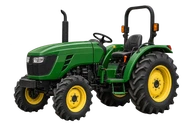
The distinction matters when a listing uses a tractor name as its main label. Deere identifies the . That name does not identify the tiller attached to it or establish the tiller’s working width. Ask for the implement’s own identity instead of copying the tractor model into the implement column.
Leave an unreadable or missing number marked unresolved. A similar hood, attachment color or model-family name does not fill that gap. The next useful request is a legible plate photograph or the document reference needed to identify the equipment.
Check which kind of implement is being offered
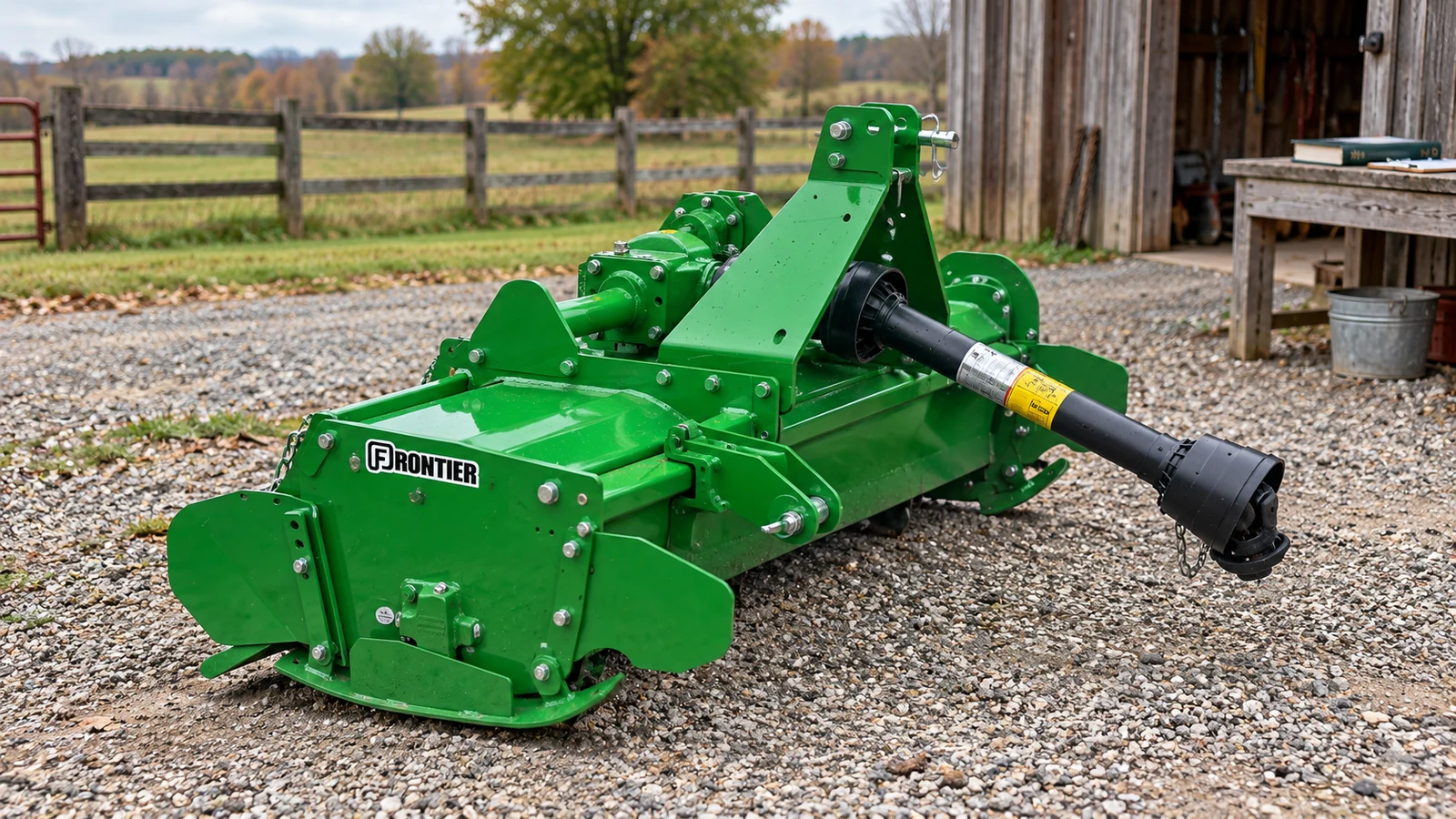
A rotary tiller, a row cultivator and a landscape rake need separate records. In Deere’s dated Frontier literature, the RT3042 is a rotary tiller, the PC1001 is an integral one-row cultivator, and the LR2060L is a landscape rake with spring-steel tines. These are identified examples of different implement classes, rather than three interchangeable tiller models. See the , PDF pages 48, 59 and 122.
Write down the job you are asking the equipment to do, then compare that description with the identified implement’s documentation. A listing that only says “garden attachment” leaves the implement class unresolved.
Treat a claim such as “bagging tiller” as a request for more evidence: an exact model, the described collection assembly and a manufacturer document showing that configuration. No such assembly has been established by the sources used here. Do not use the label as evidence that a tiller collects rocks or weeds, or connects to a mower bagger.
Compare hitch, PTO and package information
Keep the original labels beside published values. Engine horsepower and tractor PTO horsepower are different fields; do not substitute one when a table asks for the other. Likewise, a hitch category or a published power range supplies one part of the comparison, rather than a complete fit decision.
The RT3042 entry in the 1 July 2024 Frontier document offers a bounded example:
| Published field | RT3042 value in that dated entry |
|---|---|
| Hitch | Limited Category 1 |
| Tractor PTO horsepower required | 15–35 hp |
| Input speed | 540 rpm |
| Working width | 42 in. |
| Overall width | 47.4 in. |
The table is a historical specification reference. It does not establish a fit for a particular tractor, serial range, current regional offering or altered implement. It also does not supply the full installation instructions. Keep its date and document page in the comparison record.
Next, separate the base implement from the package being offered. Ask for an itemized description of the hitch hardware, driveline and any model-specific components included with that exact configuration. Check the itemization against the matching equipment documents. Do not assume that a photograph shows everything included, or that “quick attach” confirms every connection and requirement.
If a requirement or component cannot be matched, record the mismatch or missing evidence. A published range that appears suitable does not resolve the remaining questions.
Keep working width separate from access dimensions
The RT3042 example lists a 42 in. working width and a 47.4 in. overall width. Using the working width as the machine’s outside width would change the access comparison. Record the label as well as the number.
For a property review, record the narrowest opening on the intended route, the space available for turns and the storage space. Compare those observations with the dimensions of the complete proposed configuration. Do not derive a maneuvering clearance or a safe operating margin from the difference between two widths. This worksheet does not supply either value.
Record site questions separately from fit questions. Describe the intended area and any known obstacles or unresolved ground conditions for the person reviewing the equipment documents. Acreage alone does not identify the attachment, establish compatibility or provide an operating plan.
Fill out a compatibility evidence sheet
Keep one sheet for each proposed tractor-and-tiller combination. Use documented, unresolved or conflicting to describe the evidence in each row. “Documented” means that the stated item has a traceable source; it is not an overall fit approval.
| Check | What to record | What keeps the question open |
|---|---|---|
| Tractor identity | Model, serial/PIN, region and matching publication | Missing plate information or uncertain document applicability |
| Implement identity | Model, serial/ID and matching manual or parts reference | A tractor name or general category used instead of the implement model |
| Interface requirements | Exact hitch and PTO fields from the relevant documents | Different labels, a mismatch or an unverified configuration |
| Complete package | Itemized included hardware and driveline, with document references | Unnamed components or assumptions based on a photograph |
| Access and storage | Configuration dimensions and observations from the intended route | Working width substituted for overall dimensions or no complete configuration |
| Intended job | Area description and questions needing manual or dealer review | An unresolved implement class or site constraint |
| Outstanding evidence | The missing item, who will supply it and its document reference | An unanswered question carried forward as a confirmed fact |
For example, a sheet with a clearly identified tractor but only “42-inch tiller” in the implement row is incomplete. The next request is the tiller’s model and identification information. A sheet with both identities but no driveline itemization has a different gap: request the package details and their applicable references.
These are document checks. They do not require trying an unidentified combination to see whether it works.
Ask for a configuration-specific answer
Send the two equipment records, the itemized package, the access observations and the unresolved rows together. Ask: “Which documentation confirms this tractor and implement configuration, what components are included, and which questions still need to be resolved?” Ask the respondent to identify the applicable model, serial/PIN or regional limits in the answer.
Keep acquisition questions about a new or used offer separate from this identity sheet. Once the equipment is identified, condition and quote completeness can be assessed for that offer. Mounting, adjustment and operation belong with the matching manual; an unresolved exact 30A application needs its own evidence. Standalone walk-behind tillers and broader field-tillage choices also require different comparisons.
Save the document title, edition or date, page and answer beside each resolved row. If two sources conflict, retain both references and ask for the applicable configuration to be clarified before treating the sheet as complete.
The Landscape Rake Attachment is the best! I can’t believe how much easier it makes clearing debris. 💪🥇 Anyone else feel the same?
So happy to hear you’re satisfied with it, Linda! The decor options are endless after you clear your space!
Totally agree! It’s been a lifesaver for my yard work. You can actually get stuff done rather than just pushing it around.
I’ve got my eye on that Tiller for Compact Tractors. Do any of you think it’s worth the investment?
Thanks for your input, Michael! It’s great for larger areas and more efficient than handheld options.
Definitely! If you have a compact tractor, it makes everything so easy. Plus, it saves time for other gardening tasks!
I feel like every time I try to till, I end up just making a mess. 😩 Has anyone else had this struggle, or is it just me?
You’re not alone, Robbie! It took me a couple of tries to get the hang of it. It helps to go slow and steady.
Practice makes perfect! Let us know if you need specific tips on tilling!
Okay but the essential tool overview is a must-read. I learned a ton and it’s made me rethink my gardening strategy! 😍 Who else felt the same?
That’s awesome to hear, Ella! Glad the info was helpful.
Yes! I found some tips I’d never thought about. I’m excited to apply that knowledge!
Just wondering if anyone has used the Bagging Tiller Attachment? I’ve heard mixed reviews. 🤔
It’s important to match the attachment to your gardening needs. What size garden do you have, Tommy?
I had it last season! It was great for my small garden, but it can get heavy if you have a lot to collect.
Can we talk about how user-friendly these tiller attachments are? As a beginner gardener, I’m impressed! 🌼
Right?! I picked up my first tiller last spring, and I was worried it’d be complicated but it really isn’t. They’ve made it simple!
Thanks for sharing, Cathy! It’s great to know that new gardeners feel comfortable using them.
Tilling has been a chore for me for years. I’m hopeful these John Deere attachments can save my back this season!
Same here! The right tools can really make a difference. Here’s to easier gardening! 🍀
Wishing you the best with your gardening, Nadia! Tools do make a huge difference.
I’m super curious about the compact tractor tiller! Anyone can confirm it’s actually worth the hype? 🤷♀️
Thanks for your insight, George! Many are excited about that attachment, Rebecca!
IT IS! If you have a compact tractor, you will wonder how you ever gardened without it.
Just trying to gauge—how big of a garden do you all have? 😅 I’m curious if I’m going overboard with my expectations here!
Great question, Luke! Size does affect how these tools perform.
I have a pretty small garden but the tiller makes it feel giant with how easy it is to manage!
What’s the toughest part about using these tillers? I’m upgrading my garden and need some real talk here. 🧐
For me, keeping the tools cleaned and maintained is a hassle. But totally worth it in the end!
Maintenance can be a dealbreaker if ignored. Consistency is key!
Why do I feel like I need all of these attachments? They’re like candy for my gardening heart! 😂
I totally get what you mean! It’s hard to choose when they all seem to have their own perks.
Haha! They do want to entice you. It’s okay to dream, Charlie!
Just ordered the Bagging Tiller Attachment—so excited! Can’t wait to try it out next weekend! Anyone have tips for a newbie?
Make sure to read the manual carefully! And practice in a small area first.
Great advice, Kathy! Practice makes perfect, Isabella!
Omg, I just bought the Rotary Tiller Attachment last week and it’s a game changer! My garden has never looked better. 🌱 What’s everyone’s favorite feature of it?
Glad you love it, Sarah! The Rotary Tiller is definitely a fan favorite for a reason!
The ease of use for sure! I was shocked at how smooth it was to get through my rocky soil. 😅
I regret not getting the John Deere attachments sooner! I’ve been adapting with others and they’re just not the same! 🙁
Glad you found the right fit now, Paul! Better late than never!
That’s a common regret I hear from others. Definitely a solid investment!