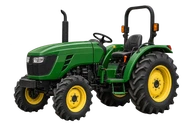
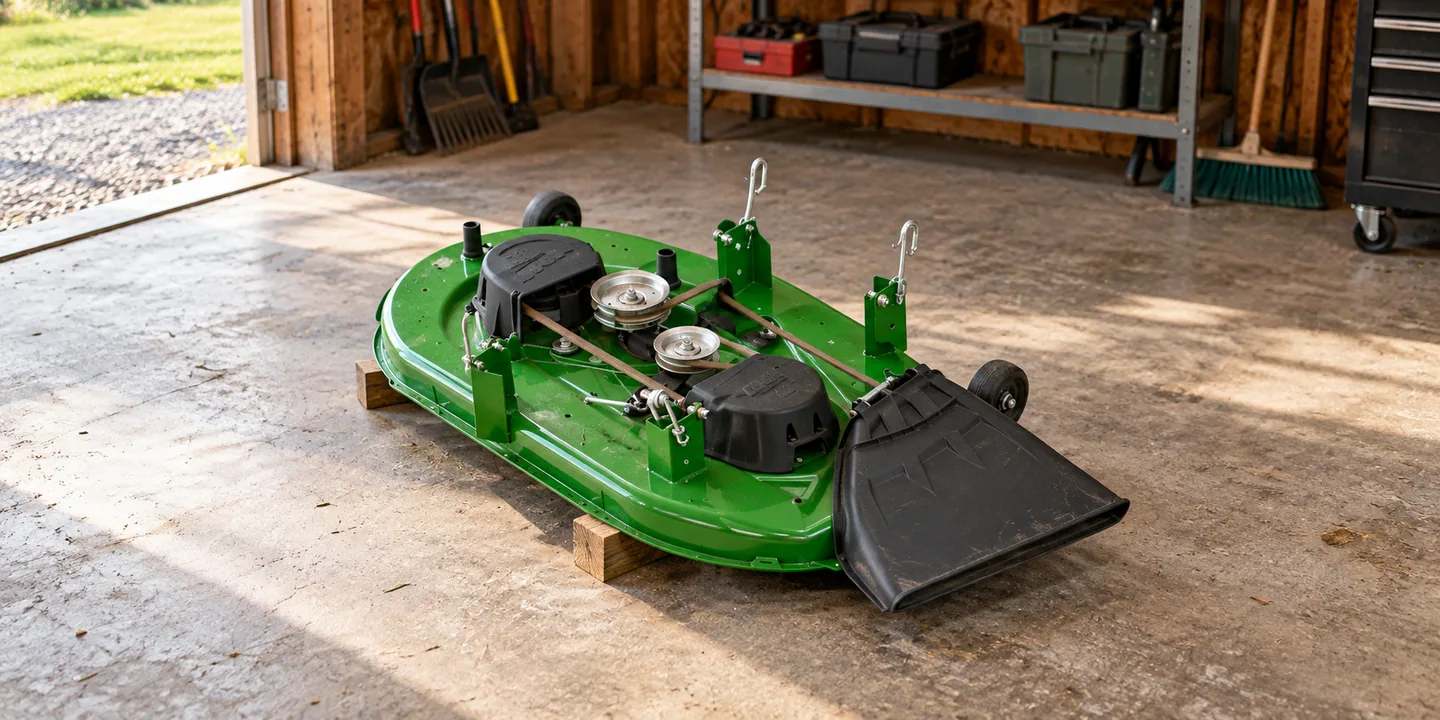
The John Deere L100's documented 42-inch deck has two blades, not three. Deere's historical deck-kit chart lists two blades and two spindle assemblies for the corresponding 42-inch rebuild kit. Before ordering anything, identify the tractor and the deck actually fitted to it: an older L100 may no longer carry its original assembly.
This guide helps you describe a cut problem, prepare a parts enquiry and decide what needs qualified inspection. It does not certify a used deck or replace the applicable operator manual.
Identify the L100 and its fitted deck
Use the as a historical identification reference. It provides separate tractor and deck serial-number fields. The supports the two-blade configuration; its old kit numbers are not a current fitment guarantee.
Record the tractor model and serial, any legible deck label, the fitted cutting width and signs of a replacement shell or altered mounting. Photograph labels and the complete stopped assembly. A seller's description of a “42-inch John Deere deck” does not establish the correct attachment points, drive arrangement or parts.
Before buying blades, a belt or a replacement deck
Ask the supplier to identify the applicable diagram and current part number from your machine and deck details. For blades, confirm the intended cutting mode, mounting arrangement and required hardware. For a belt, confirm the deck and drive configuration. Blade length, belt appearance and a broad online model list are insufficient on their own.
The operator manual has separate 42- and 48-inch deck procedures. Use the branch that matches the installed assembly; a larger deck's belt instructions are not an L100 upgrade guide. Keep the supplier's written answer with the diagram reference and any unresolved question.
Uneven cutting: record the symptom before changing parts
A stripe, low patch or ragged edge does not identify one failed component. Write down where the problem occurs, whether it follows each pass, the selected height and any recent blade, belt or wheel work. Photographs of the cut can help a service enquiry; they cannot show the condition of hidden components.
The separates tire pressure, deck level and deck-wheel adjustment. Its leveling check uses a level surface and blade-tip measurements. The deck wheels must not support the mower's weight. Setting every wheel to an arbitrary matching hole is not a substitute for checking deck level.
An observation sheet for a cut complaint
| What you notice | What to record | What still needs checking |
|---|---|---|
| One side cuts lower | Direction of travel, height setting and where it repeats | Applicable tire-pressure and deck-level checks |
| Ragged or missed grass | Conditions, pattern and recent blade work | Blade condition and correct installed parts |
| Vibration or a new noise | When it started and whether there was an impact | Stop-use assessment by qualified service |
| Repeated plugging | Cutting mode, material conditions and where buildup occurs | Correct configuration and the cause of obstruction |
| Engine falters when the deck engages | The sequence and any other symptoms | Tractor and deck diagnosis; do not assume a fuel filter fixes it |
Stop before inspecting underneath
Do not reach into a running or coasting deck. Follow the applicable manual's safe parking, starting-prevention and support instructions before inspection or service; a lift lever alone is not a work support. If damage, vibration, a missing guard or an uncertain setup prevents a safe inspection, leave the machine out of use and arrange qualified help.
The manual's unplugging section requires the engine stopped and all moving parts stationary before inspection. Its service chapter treats belt tension and spindle brakes as related checks on the 42-inch deck. Repeated belt trouble is therefore a reason to check the complete arrangement, rather than tightening a belt until it seems satisfactory.
Repair or replace: ask for a condition-based scope
For a used or damaged deck, ask a qualified repairer to separate shell condition, mounting points, spindles, drive parts, blades, guards and missing hardware in the estimate. List what will be reused, what needs replacement and what cannot yet be assessed. A low asking price is difficult to compare with a repaired assembly until those omissions are visible.
Do not infer service life or a smooth cut from fresh paint, a clean underside or a short demonstration. A useful quotation identifies the fitted assembly, the reason for each proposed part and the remaining uncertainty. This page has no field-test data or verified owner survey supporting a durability or time-saving claim.
Care instructions must match the deck
Use the applicable manual for cleaning access, blade handling, lubrication and storage. Do not treat pressure-washing after every use, annual sharpening or greasing every spindle as universal L100 instructions.
The covers blade inspection and balancing after sharpening, and says damaged blades must not be straightened or welded. The specifies spray lubricant for the 42-inch deck's blade-brake and idler pivots. That is not an instruction to force grease into every visible joint.
Optional tools for a documented deck check
Use a tool only when the manual's procedure and safe access are clear. These two items support measurement or observation; neither establishes deck condition.

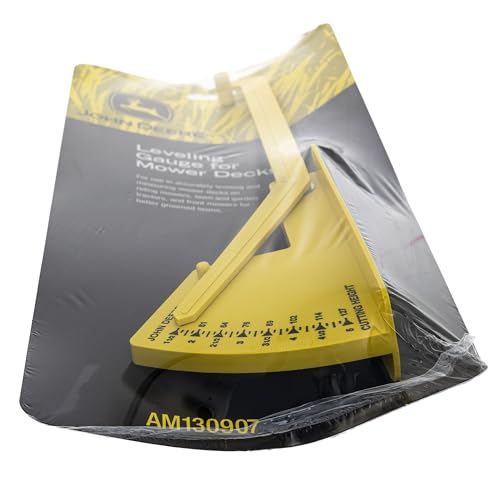
John Deere AM130907 deck-level gauge
Deere names this gauge in the L100 reference material and leveling instructions. Use it for the specified blade-tip measurement on a safely prepared machine; the gauge does not set tire pressure or adjust the deck for you.

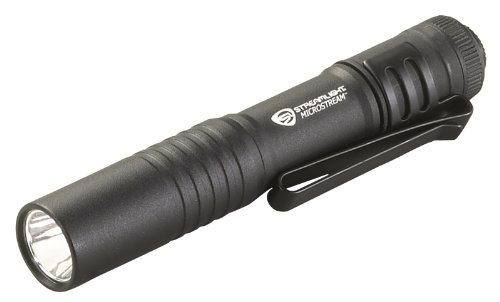
Streamlight MicroStream 66318 pocket light
A compact light for reading an accessible deck label and recording visible condition with the machine stopped. It does not make unsupported access beneath a deck safe.
As an Amazon Associate I earn from qualifying purchases.
Check attachments as a complete configuration
For mulching or collection, ask which cover, chute, blades, mounting pieces and other required components apply to the installed deck. The manual distinguishes discharge and mulching arrangements; buying one component does not confirm that the conversion is complete.
Treat a striping kit, bagger or tire change as a separate compatibility enquiry. Ask about the complete machine configuration and operating restrictions. No accessory on this page is presented as making slopes safe or guaranteeing a better cut.
Questions before the next parts order
Does the L100 42-inch deck use three blades?
No. The Deere references used here document a two-blade configuration. If the fitted deck looks different, identify it before ordering rather than using the tractor badge as proof.
Can a level gauge solve every uneven-cut problem?
No. It measures a specific clearance within the manual's check. A cut complaint can still require examination of the installed parts, condition and setup.
Which replacement deck or kit should I order?
Get written confirmation against the actual tractor, deck identity and current diagram. This guide does not certify a current replacement kit or a modified assembly.
Send a complete L100 deck enquiry
Copy this record into your message: tractor model/serial; deck label and width; photographs; symptom and onset; recent work; intended discharge/mulch/collection mode; diagram or old part markings; questions still unresolved. Ask for the applicable manual, current part number, required hardware and any inspection needed before purchase. Keep “not yet confirmed” separate from “fits.”
I’ve had my L100 Deck for a few years now, and honestly, it’s been pretty good. But I’ve had some issues with the belt slipping. 😒 Anyone else face this? I followed the troubleshooting section, but still having trouble.
I had that issue too! Turns out, it might just need a good cleaning. Try checking the tension, and make sure nothing is stuck.
Hi Tommy, sorry to hear you’re having trouble! Have you checked the alignment of the belt? Sometimes that can cause slipping.
Yeah, I’ll give that a shot! Thanks for the tips, really appreciate it.
I just got the John Deere L100 Deck, and wow, what a difference! My lawn looks like a golf course now! 😍 I was worried about maintenance, but the tips in the article made it seem easy. Has anyone else tried the upgrade options? I’m thinking of getting the mulching kit!
Congrats on the new deck! I added the mulching kit last summer, and it really works wonders. Zero clumps and a nice finish! Just make sure to keep the blades sharp.
Thanks for sharing your experience, Sarah! The mulching kit is a great choice for a healthy lawn.
So, my buddy swears by the L100 Deck, but I’m still on the fence. The price tag makes me hesitate. Is it really that great, or is it just hype? 🤔
Hey Kevin! Many users have shared positive experiences, especially regarding the ease of use and performance.
I was skeptical too, but once I tried it, I was sold! It’s definitely more than just hype.
Thanks for the feedback! I guess I need to try it for myself. Might just borrow my buddy’s for a test run!
This article is super informative! My dad has one of these decks, and I always thought it was just a lawn mower. 😂 It’s cool to learn about the features and benefits. I’m all about that easy maintenance life!
Glad you found it useful, Mark! The L100 Deck really is a step up from your typical mower.
Totally with you, Mark! I love how easy it is to maintain. Makes it more fun to mow!
I’ve been considering getting the L100 Deck, but I’m a bit torn. The price is kinda high, but I hear it’s worth it? Anyone have thoughts on the long-term value?
Hi Nancy! Many users report that the durability and performance justify the price in the long run.
Thanks for the input, guys! Might just have to take the plunge!
Honestly, I think it’s worth every penny. I’ve saved so much on repairs and it just works like a champ.