Updated
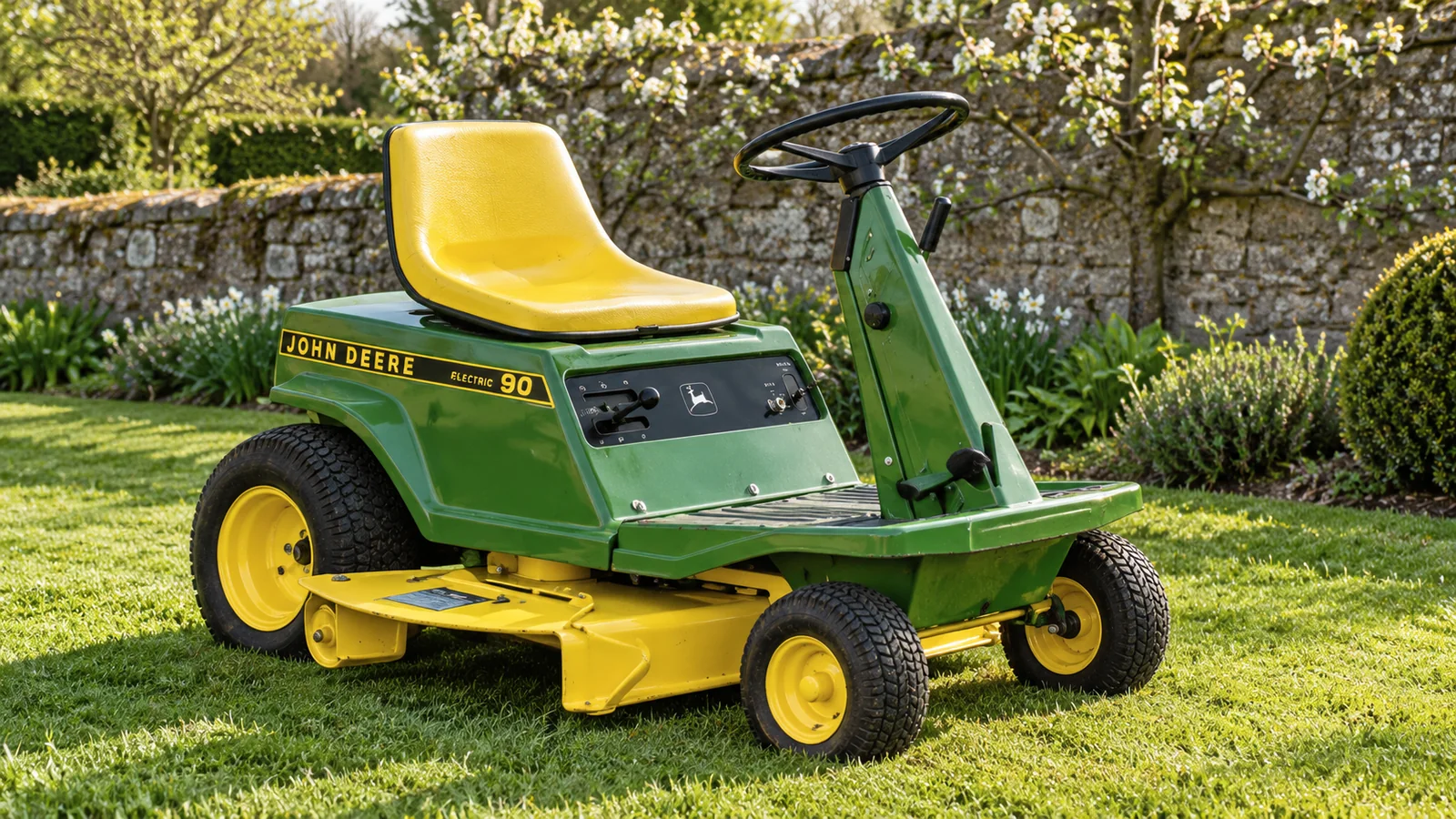
Deere brochure A-51-72-5 calls this riding mower the Electric 90. If you are researching an E90 listing, compare its badge, layout and components with that documentation before treating it as the same model. The original design uses electric traction and mower motors, so a gasoline-engine service checklist does not apply.
For a surviving E90, establish what is still original before buying batteries, a charger or mower parts. A model badge identifies the machine; it does not establish the condition or specification of components fitted decades later.
What the Electric 90 brochure actually specifies
Deere describes one traction motor and two mower motors. The mower has a 34-inch cutting width and two directly driven blades. These details distinguish it from a gasoline riding mower and from a walk-behind tool with handles.
| Original feature | Brochure specification | What to verify on the machine |
|---|---|---|
| Battery supply | Three 12-volt motive-power batteries | Labels, battery type and any conversion records |
| Motor voltage | 36 volts DC for traction and mower motors | Motor identification and wiring documentation |
| Cutting system | 34-inch width; two directly driven blades | Actual deck, motors, guards and blade identification |
| Height of cut | 1 to 4 inches above ground | Complete lift and height-setting mechanism |
| Charger input | 100/125 V AC household current | Installed charger label, supply requirements and condition |
| Approximate curb weight | 475 pounds | Present weight and transport requirements after modifications |
| Width including mower | 43 inches | Actual widest point, gate and storage clearance |
These are historical design specifications, not a compatibility certificate for a replacement component. The brochure gives no basis for a 0.9-HP gasoline-engine specification.
Will an old E90 still mow for the advertised time?
The brochure describes approximately one and a half hours and about an acre in average conditions. That is an original marketing statement, not a present-day range test. Battery condition, replacement type, modifications and mowing conditions have to be established for the particular machine.
Do not price an E90 on the assumption that a brief demonstration proves that historical endurance. Ask the seller to document the installed batteries and the machine’s recent use; an unverified claim of a full charge leaves usable capacity unresolved.
Match the Electric 90 serial range and manual
Deere’s PC-1279 parts catalog dated January 28, 1977 lists Electric 90 and Electric 96 separately. Its printed page 1 gives these Electric 90 entries:
| Model year | Machine serial-number range |
|---|---|
| 1972 | 1001–10000 |
| 1973 | 10001–11704 |
| 1974 | 11705–13204 |
These are the entries in this catalog edition, not proof that every surviving mower retains its original components. Record the full machine identification and read each part’s serial restriction. PC-1279 separates Electric 90 charger sections through serial 11704 and from 11705 onward; its Electric 96 section is separate. A shared catalog does not establish interchangeability.
A period reference is the . Its contents place general maintenance on printed pages 9–10, adjustments and service on 11–13, and storage and troubleshooting on page 13. Verify the publication against the complete machine identification and installed configuration before following it; this edition is not presented as applicable to every Electric 90. The supplies historical diagrams and part numbers. These Deere-authored scans have an independent collector host.
Check the battery and charger before ordering replacements
The brochure specifies motive-power batteries designed for cycle life and deep charging. Three 12-volt labels alone are not enough to select replacements: confirm the required battery type, dimensions, restraint, terminal arrangement and charging specification through the applicable documentation and a competent service provider.
A 12-volt starting-battery maintainer is not a substitute for the E90’s documented 36-volt motor supply. Do not attach a general-purpose charger to the pack merely because its connector can be made to fit.
The original brochure describes an onboard charger and gives historical charging times. Those details do not validate a surviving charger, replacement batteries or a modified charging circuit. Have the installed charging system assessed before energizing an unknown machine; do not use this brochure as an electrical repair or charging procedure.
Photograph accessible battery and charger labels without disturbing wiring. Record the battery make and type, charger model and output, and any dated conversion invoice. Missing labels or undocumented wiring changes belong on the unresolved-cost list before an offer is agreed.
Inspect the mower as a complete system
Start with a stationary inspection under the applicable operator’s manual. Confirm safe isolation before approaching blades, belts or electrical components. If the machine cannot be secured safely or the operating instructions are missing, arrange professional assessment instead of an improvised demonstration.
Look for the deck, both mower motors, covers, guards, lift parts and discharge components. Record missing or visibly damaged items separately; a complete-looking painted shell does not establish that the cutting system is ready to operate.
The brochure describes a key switch for traction, a mower toggle and a clutch-dependent starting condition. It also describes a restart condition after the key is turned off. These descriptions help identify original controls; test their actual functions only through the correct manual and a qualified operator. Never bypass an interlock to complete a sale demonstration.
Check steering play, wheel condition, visible corrosion and the condition of the brake controls while the mower is secured. Whether the machine stops, steers and cuts correctly needs a permitted demonstration after safety checks, not an inference from photographs.
For uneven cutting, confirm the correct tire pressures, deck setup and blade condition from the manual before selecting parts. For abnormal heat, smoke or vibration, stop using the mower and obtain service diagnosis. The brochure’s thermal motor protection is not a reason to keep operating a machine with a fault.
Which accessories did Deere show for the Electric 90?
The brochure shows the Model 50 dump cart and 38-inch front blade, and mentions a trailer-type lawn sweeper and a 20-gallon sprayer. This is evidence of equipment offered with the original machine, not approval for any modern product sharing those dimensions.
For an accessory included in a sale, obtain its identity, mounting hardware and operating documentation. Check the E90’s applicable instructions for approved use and limits. Do not transfer the cart’s quoted load capacity into an unrestricted towing rating for the mower.
The E90’s mower deck is not a hedge trimmer or edging attachment. Use equipment intended for those separate jobs rather than following instructions to trim branches or run mower blades along a hard border.
Plan restoration costs before committing
Separate the purchase price from the cost of making the machine usable. Get written estimates for the unresolved battery and charger work, missing mower components and any steering or brake faults. Confirm whether a supplier can actually identify and provide the required parts before treating a low asking price as good value.
A practical purchase record has five entries: machine identity, installed electrical components, deck completeness, safety defects and priced repairs. If the seller cannot establish an item, keep it unresolved rather than converting it into an assumed inexpensive fix.
For service and storage, use the applicable operator’s manual for the installed configuration. The original Electric 90 does not need gasoline-engine spark plugs, engine air filters or fuel stabilizer. Battery care, lubrication and the mower’s other service requirements still need the correct instructions.
Evidence and next step
The model facts above come from the , including its specification page. The brochure is historical sales literature, not a current inspection certificate or full operator’s manual. Deere’s is a starting point for locating model-appropriate publications.
Before buying, collect the identification photographs and missing-parts list, then ask a service provider to resolve the electrical and safety questions. Whether this particular E90 is a usable mower, a restoration project or a purchase to decline depends on that evidence.
The Electric 96 model record covers the other named historical mower. The Electric Series Rear-Engine Riders archive links the two records.
I’m still figuring out the maintenance part. Anyone have a good schedule they follow for keeping the E90 in top shape?
I do the same! Plus, I check the oil levels regularly.
Great question, George! A good rule of thumb is to clean it after every use and sharpen the blades monthly.
Just got my John Deere E90 and wow, it’s a game changer! 🌱 I never thought lawn care could be this easy. Setting it up was a breeze, and my grass has never looked better. Anyone else love how lightweight it is?
Thanks for sharing, Sarah! We’re glad to hear you’re enjoying your E90.
I’m thinking about getting one too! How’s the battery life so far?
Honestly, I’m not sold on this. My neighbor swears by it, but I feel like there are better options out there. What do you guys think?
Hey Eric, it really depends on your lawn care needs! What are you looking for in a mower?
I’ve had mine for a year, and it’s been great. What features are you missing?
Anyone else notice that the E90 has a bit of a learning curve? The first time I used it, I felt like I was wrestling with a lawnmower, haha!
Haha, yes! I almost crashed into my flower bed! Just takes a bit to get the hang of it.
That’s a common experience, Carlos! It gets easier with practice.
The John Deere E90 has been a lifesaver for my back! My old mower was so heavy, I almost threw my back out every time. I recommend it to everyone!
Absolutely! I was surprised how easy it was to maneuver. No more sore muscles!
Thanks for the recommendation, Natalie! Comfort is key!
Great article, but I wish it went more in-depth about the maintenance section. I mean, what does ‘check the blades’ really mean? 🤔 Like, how often should I do that?
Totally get that! I usually sharpen mine every month, but it depends on how much grass you’re cutting!
Hi Tommy, it’s recommended to check the blades every 5-6 uses, but it can vary based on your lawn size!
Is it just me, or does anyone else feel like a professional landscaper now? 😂 Love how my lawn looks! Thanks, John Deere!
You’re definitely not alone, Samantha! It’s amazing how a good tool can boost your confidence.
Haha, right? I’m trying to convince my friends to hire me for their lawns!
Just finished my first mow with the E90, and I’m in love! 😍 It cut through my lawn like a hot knife through butter. Highly recommend it!
Right? It’s such a smooth ride! Have you tried the mulching feature?
So glad to hear that, Hannah! What lawn care techniques are you trying next?
I appreciate the section on troubleshooting. I had an issue with mine not starting, but the tips helped me fix it. Thanks for the guidance! 🙌
Happy to help, Patricia! Glad you got it sorted out.
What was the issue? I’m having starting problems too!
It turned out I just needed to charge it fully. Make sure you check that!
I had high hopes, but I’m not sure it’s worth the hype. My E90 is fine, but I expected more power. Is that just me?
Lily, it might depend on your lawn type. What are you mowing through?
I think it’s great for smaller yards. Bigger lawns, yeah, maybe not so much.
Reading this article made me realize I’m doing it all wrong. 😂 I’m definitely going to try the techniques mentioned here!
Same here! I learned a ton just from reading this.
Glad you found it helpful, Oliver! Which techniques are you excited to try?
I love the E90, but I had a bit of a hassle with the setup. 😅 Anyone else feel like the instructions could be clearer? I almost gave up halfway through!
I had the same issue! I watched a YouTube video, and it made it way easier.
Sorry to hear that, Emily! We appreciate the feedback on the setup instructions.
This E90 is like the Swiss Army knife of lawn care! It has everything I need in one. But I do wonder, do I need to buy extra attachments or anything?
Hey Ben, the E90 comes with most essentials, but optional attachments are available for specific tasks.
I got some attachments for mine! They really expand what you can do.