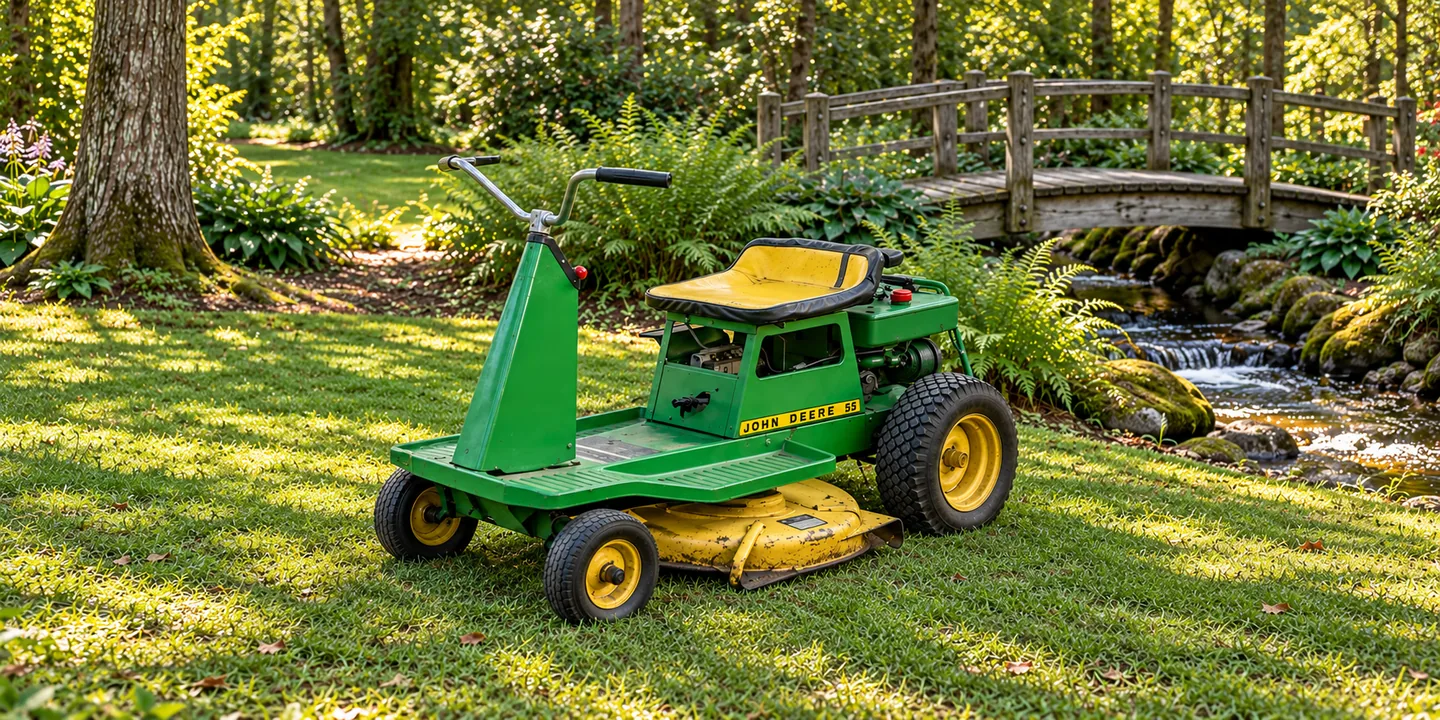
The John Deere 55 covered here is the small rear-engine riding mower, not the 55 combine. For a used example, first establish what machine and equipment are actually included. A running engine does not show whether the mower is complete, whether its parts match the seller's description or what work remains.
Start with three records: the mower identification, the installed engine identification and the fitted cutting equipment. Use those records to find applicable publications and request parts. This guide is an inspection worksheet, not an operating or repair procedure.
Identify the 55 before assessing condition
lists the 55 under Riding Mowers. That establishes the equipment family; the chart does not identify the components fitted to a machine offered for sale.
Ask for clear photographs of the identification markings and both sides of the machine. Keep an unreadable or missing number marked as unknown. Do not replace it with a guessed year from paint, a seat or a seller's recollection.
Photograph the engine's own identification separately. A model name or old horsepower label cannot establish what engine is installed now. Record any disclosed engine replacement, alteration or undocumented repair.
Use to find publications for the identified equipment. Ask the supplier to confirm applicability if the serial range or publication edition is unclear.
Make an inventory of the mower, not just the engine
For a machine intended to mow, the cutting equipment and its mounting parts need as much attention as the engine. Ask the seller to identify which items are included and which have been removed. Compare the assembled machine with the applicable parts illustrations; a photograph of a loose component is not proof that the required hardware is present.
| Record | What to collect | Question it resolves |
|---|---|---|
| Machine | Identification markings and full-machine photographs | Which mower and publications are relevant? |
| Engine | Engine markings and replacement history | Which engine documentation and service parts should be checked? |
| Cutting equipment | Identification, visible condition, mounting and drive components | Is there an identifiable assembly to assess for mowing? |
| Missing or altered items | Written list, photographs and any removed parts included in the sale | What must be sourced or assessed before use? |
Record visible damage, corrosion, previous repairs and missing guards without calling them harmless or condemning the whole machine from a picture. If the condition of a load-bearing, steering or cutting component is uncertain, obtain a qualified assessment before relying on it.
Optional tools for the identification visit
Use tools only where the equipment is shut down and secured, components have stopped and the relevant manual permits the access. Do not reach beneath an unsupported mower or turn an inaccessible check into a risky one. Existing suitable tools are enough; these are optional purchases.

Ullman HTC-2 inspection mirror
View an accessible identification marking or mounting point outside a direct line of sight. Keep the mirror clear of hot, moving or energized components; it cannot confirm hidden wear or part compatibility.

Komelon SL2825 tape measure
Record the actual machine and fitted equipment dimensions against a gate or storage opening. Keep the same measurement points in your notes; a clearance measurement does not establish blade, belt or attachment fitment.


As an Amazon Associate I earn from qualifying purchases.
Separate a static inspection from a running demonstration
Read the applicable operator's manual before a demonstration. If the controls, stopping method or safe condition are uncertain, have a qualified person assess the mower rather than trying a guessed operating sequence.
Ask the owner to demonstrate the machine only where the site and its condition allow. Record what was observed: starting conditions, steering response, braking and whether the cutting equipment was demonstrated. Mark an omitted check as not demonstrated, not as passed.
Stop the demonstration if movement, steering, braking or mower control is unpredictable. A short run cannot establish remaining engine life, repair quality or reliability through a season.
A clean finish also needs evidence from the particular machine and the intended conditions. Do not infer wet-grass capability, acceptable noise, a cutting-height range or slope suitability from its compact appearance. Check the applicable operating limits and the actual site before deciding whether it can do the work.
Decide whether you need a working mower or a project
The same machine can be a poor match for immediate mowing and an acceptable restoration project. State the intended outcome before comparing offers.
| Intended use | Evidence needed before committing | Keep unresolved until confirmed |
|---|---|---|
| Mow with it | Complete cutting equipment, applicable instructions and an acceptable condition assessment | Any undemonstrated function or essential safety question |
| Restore it | Identifiable assemblies, a missing-item list and a credible source for essential parts | Availability, delivery time and work outside the quoted scope |
| Display or collect it | Identity, condition photographs and a clear account of alterations | Originality claims without supporting records |
Measure the actual transport and storage requirements. Confirm how a non-running machine will be collected and handled; do not assume it can be driven onto a trailer.
Keep purchase, collection, inspection and identified repairs as separate cost entries. There is no verified current price or restoration total in this guide. A low asking price does not resolve an unknown supply problem.
Order service items from component evidence
Take the machine, engine and cutting-equipment records to a Deere parts specialist or the relevant component supplier. Ask for the applicable part number, any supersession and the quantity required. A similar photograph or a listing that mentions John Deere is insufficient evidence of fit.
Do not choose an oil, filter, plug, blade, belt, seat or battery from the 55 name alone. Check the installed equipment and its documentation. This page does not establish an Amazon replacement kit for the 55.
Use the applicable engine and mower instructions for service intervals, fluids, storage and adjustments. A generic 50-hour oil-change rule is not a verified schedule for the machine in front of you.
Before authorizing work, request a written description of the fault, the proposed work and what remains unpriced. If the assessment changes after disassembly, obtain a revised scope rather than treating the first estimate as a guaranteed total.
Questions to settle before making an offer
Can a working engine make an incomplete 55 ready to mow?
No. Confirm the cutting assembly, its required mounting and drive parts, the guards and the condition of the assembled machine. Engine operation alone leaves those questions unanswered.
Can the photograph identify every replacement part?
No. Use identification markings, applicable diagrams and supplier confirmation. Record an unknown component as unknown instead of filling the gap with another model's specifications.
How should owner comments affect the decision?
A dated account tied to the same machine can explain repairs or symptoms. Untraceable praise and stories about another mower cannot establish this one's condition or remaining life.
Make the offer from a written record of identity, included equipment, demonstrated functions, missing items and unresolved costs. Resolve essential operating or parts questions first, or explicitly accept the mower as a project with those uncertainties recorded.
Sources and scope
John Deere's historical fluid-capacity chart supports the 55 riding-mower identity only. Consult the applicable operator, engine and parts publications for the actual machine; this article does not provide model-specific capacities or service settings.
No first-hand mowing test, measured repair cost, fuel or noise comparison, owner survey or reliability study is claimed here. The inventory and buying checks are editorial guidance, not a Deere acceptance procedure.
Honestly, I’m not impressed. I had high hopes but the maneuverability isn’t as great as I expected. It struggles to get around tight corners. 😒 Anyone else feel that way?
Sorry to hear that, Derek! Maneuverability can vary with different yard shapes.
@Jessica L, exactly! If only it could turn on a dime, lol.
I totally get what you mean. I have a bunch of flower beds and it’s a pain to navigate.
I just got my John Deere 55 and wow, what a beast! 🚜💨 I’ve used it a couple of times now and the engine is super powerful. The cutting quality is impressive too, my lawn has never looked better! Just wish I had bought it sooner. Any tips for first-time users?
Hey Linda, congrats! How does it handle on hills? I’ve got a pretty sloped yard.
@Tommy R, it does pretty well! Just take it slow; I had a moment where I thought I was gonna roll down! 😅
Thanks for your feedback, Linda! Make sure to regularly check the oil and keep the blades sharp for the best performance.
Hills can be tricky! Always remember to maintain a steady speed.
Just got mine a week ago and I’m loving it! The engine is super quiet compared to my old mower. 😍 Makes mowing feel less like a chore! How are the long-term maintenance costs?
Great to hear, Brian! Maintenance is generally affordable, but it’s always good to keep an eye on parts that might need replacing.
Sure thing, Tommy! Regular oil changes and blade sharpening are your main costs, around $50-$100 a year.
@admin, can you give us a ballpark on those costs?
I’ve been eyeing this mower for a while. The reviews are mixed though… Some say it’s easy to use, others say it’s a pain. 🤷♀️ What’s the final verdict?
@admin, I think that’s fair. It’s like any tool, right? Gotta get the feel for it.
It really depends on your yard and experience level, Emily. Many find it easy, but there’s a learning curve.
Thanks for the insight! I might just take the plunge and get one! Wish me luck! ✨
The build quality is solid but I was expecting a bit more from the cutting mechanism. It does a decent job, but sometimes it leaves patches. 🤔 Anyone else having that issue?
Good point, Sara! Regular maintenance is key to keeping that cutting mechanism in top shape.
I’ve noticed that too, Mark. The blades might need sharpening more often than I thought.
@Sara Young, yeah, I guess I’ll have to check that out. I thought it was just me being picky!