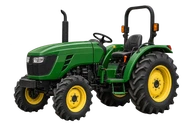
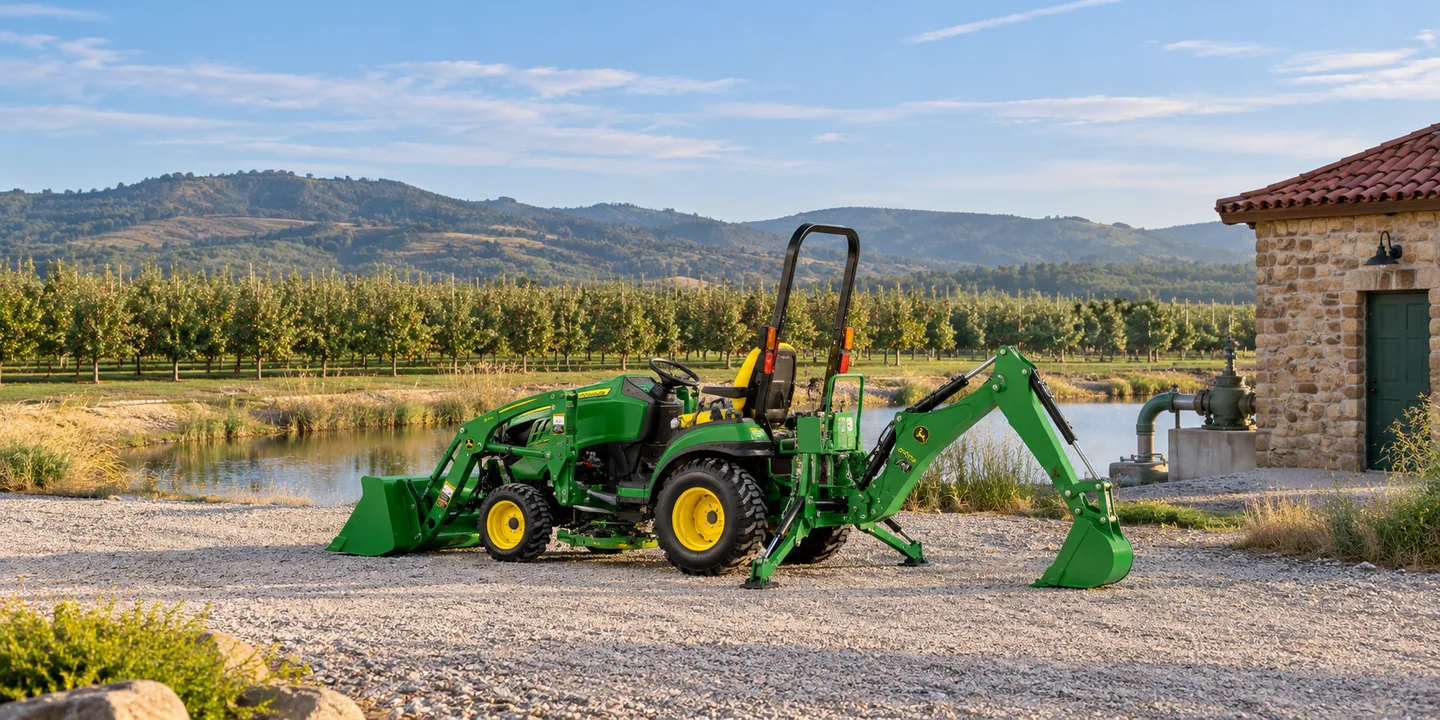
A compact tractor backhoe needs an approved tractor installation and a suitable work site. The John Deere 1025R with a 260B provides a documented example, but the tractor name alone does not settle mounting, hydraulics or job suitability. Before ordering equipment, identify the machine and describe the excavation. This guide is based on published documentation, not a hands-on test or an installation procedure.
Confirm the tractor and backhoe combination first
Deere’s May 2026 US document lists the 260B for 1023E/1025R tractors built after July 14, 2017, and 2025R tractors built after 2017. The same document separately lists subframe mounting option 1003 for 2025R tractors built from July 2017 through model year 2020. Have a Deere dealer check the applicable entry, tractor serial number and mounting parts before ordering. The listing requires a front loader and power-beyond kit, with model-year-specific mounting options. The listing does not resolve every earlier tractor or used attachment.
For a used 1025R or loose backhoe, collect the tractor serial number, backhoe identification and the part numbers already installed. Have a Deere dealer check the combination and any missing mounting or hydraulic components. Colour, a seller’s model tag and a three-point-hitch category do not approve an installation.
What the installation must account for
The 260B uses a subframe. Deere describes a power-beyond hydraulic connection and says that this kit is not included with the subframe and must be ordered separately. This is more specific than simply having hydraulic outlets at the rear of the tractor.
Ask for a written equipment list that identifies the subframe, hydraulic kit, required front loader and attachment instructions for the exact tractor. Do not substitute a generic hose or mounting kit based on appearance. These are purchasing checks; connection, pressure relief and installation must follow the applicable manuals.
Match the digging job to documented dimensions
Describe the excavation before comparing attachments: required depth, trench or hole width, access route, working space and where excavated material will go. Include the ground conditions and nearby structures. A bucket width or advertised maximum depth does not, by itself, establish that the whole job is suitable.
The listed 1023E/1025R configuration has a published digging depth of 6 ft 2.5 in (1.892 m). This is a configured specification, not this page’s measurement or usable depth at every reach. Check the installation’s full specifications and instructions before accepting a job.
| Proposed job | Information still needed before choosing equipment |
|---|---|
| Garden or landscaping excavation | Defined hole/trench dimensions, utility clearance and room to work |
| Work near a building | Site assessment, structural constraints and an excavation plan |
| Roots, stumps or rocky ground | Actual material and obstruction assessment; no removal guarantee from bucket size |
| Long or repeated trenches | Required reach, repositioning space, spoil handling and available operator capability |
If the job requirements cannot be checked against the installation’s documentation, obtain a site-specific assessment or compare an appropriate rental/contractor option. This is a decision to investigate alternatives, not a claim that a particular excavator will be faster or cheaper.
Equipment & supplies
Record the dimensions for your equipment discussion
Record accessible ground-level dimensions for the proposed job. A tape does not locate utilities or establish safe excavation or trench-entry limits; complete the site checks in the next section.

Komelon Self Lock tape measure
Record accessible ground-level dimensions for an equipment and site discussion with a dealer or rental provider.

As an Amazon Associate I earn from qualifying purchases.
Clear utilities and site hazards before excavation
In the US, contact 811 or the state one-call service before digging, including garden and landscaping projects. Follow the ticket instructions, wait the required period and confirm all utilities have responded. Rules vary by state; an elapsed waiting period alone does not prove the site is clear.
Private facilities can require a separate locate: Indiana 811, for example, explains that some privately owned utilities are not marked by its member utilities. Ask the relevant state service and property owner what the locate covers. Do not treat an unmarked area as proof that no buried line exists.
Trench entry is a separate safety issue from operating the backhoe. OSHA identifies cave-ins, access, material near trench edges, water and atmospheric hazards, and says not to enter a trench without proper inspection. Its workplace guidance is not a homeowner-specific legal determination or a trench-protection design for a particular site. Obtain qualified assessment rather than using the attachment’s digging depth as a safe-entry limit.
Separate bucket options from guaranteed capability
The US document lists 8-, 12- and 16-inch buckets and an optional mechanical thumb. Availability does not establish suitability for unknown soil, objects or lifting tasks. Verify the attachment’s instructions; do not infer tool-free bucket changes or general-purpose lifting capability.
Split the landscaping project into excavation, material handling, and finishing or grading tasks. Keep those tasks separate when requesting advice. The backhoe’s presence does not establish GPS-controlled grading, automatic stability control or an ability to remove every stump or rock.
Plan access, transport and removal from the matching manuals
Deere describes step access, handholds, stabilizers and boom/swing transport locks for the 260B. Its page also says that, although the mid-mower can remain compatible, mowing with the backhoe installed is not recommended because of overall length and ground compaction. The same page labels its abbreviated removal instructions as reference material rather than an operating procedure.
Use the tractor and backhoe manuals for setup, stabilizer use, transport locking, attachment removal and service precautions. Do not follow a shortened online sequence or assume that controls and safeguards on another backhoe are interchangeable. If instructions are missing, obtain them before use; a photograph or a seller’s demonstration does not replace the correct manual.
Take these questions to the dealer or rental provider
Request a configuration and job review that answers three questions:
- Is this exact tractor/backhoe combination approved, and which mounting, loader and hydraulic components are required?
- Do the documented dimensions and limits cover the proposed excavation and the available site space?
- Which operator instructions, training and site checks are needed before the machine is used?
Keep the equipment IDs and written answers with the manuals. This page does not establish fitment for an unidentified attachment, a safe slope or lifting limit, a fuel-saving percentage or a promised completion time.
Wow, I had no idea backhoes could be used for creative projects! The part about enhancing projects really caught my attention. What kind of creative projects are you guys working on? Thinking about using mine for something fun! 🎨✨
Just last weekend I used mine to create a cool fire pit area in my yard. It was super fun! 🔥
That sounds awesome, Rob! How did you start? Any tips for a newbie? 😄
Great question, Emily! Lots of users have tried unique landscaping designs or even art installations.
I read the section about user-friendly features and totally agree — I’m not exactly a machinery expert! 😂 So, having a simple control panel made my life easier. Any chance you can do a detailed tutorial next time? That would be super helpful for newbies like me!
Thanks for the suggestion, Tina! We’ll definitely consider doing a tutorial for user-friendly features.
Glad I’m not alone, Sam! 😂 Sometimes I feel like I’m in a video game trying to figure out the controls.
I’m with you on that! A tutorial would be a lifesaver. I kind of winged it and had a few funny moments!
I absolutely loved reading about your journey with the John Deere backhoe attachments! 😍 We just got one for our small landscaping business, and it’s been a GAME CHANGER. We were struggling with heavy lifting and digging, but now it feels like a piece of cake! Anyone have tips on the best attachments for flower beds? 🌼
Thanks for sharing, John! The auger is definitely a favorite for planting tasks.
Hey Sarah! For flower beds, I found the auger attachment super helpful. It makes planting bulbs so much easier! 🌷
Great article! But honestly, I think the John Deere stuff is a bit overrated. Sure, it gets the job done but does it really do anything that other brands can’t? I mean, come on. Sometimes I feel like they just market the green paint more than the power. 🤔
@MikeWills I get where you’re coming from. But sometimes it’s about reliability too—not just the specs.
True! Every brand has its strengths, but for some, the ease of use is worth the investment.
I see what you mean, Mike. But I think the user-friendly features are what set them apart. You can literally just hop on and start working! 🙌
The versatility you mentioned is spot on! We’ve used our backhoe coming back from job sites, helping neighbors, and even digging a small pond in our backyard. 🐸 But please, always remember to check your attachments before getting started! Learned that the hard way the first time out. 🤦♂️
Good tip, Jake! Always a good idea to double-check everything before you dive in.
Haha, we’ve all been there, right? 😆 Checking what’s attached can save a lot of headaches!