Updated
Choose a vintage John Deere garden-tractor project by the machine you can identify and the work you can document. A model name or fresh paint does not establish:
- What equipment is fitted.
- What is missing.
- What it will take to reach your intended result.
Use this worksheet before buying a project or deciding how far to take one you already own. It separates a historical reference from evidence about an individual tractor. The worksheet is editorial planning advice; operating and repair decisions require instructions matched to the equipment and an appropriate mechanical assessment.
Define the result before choosing a tractor
Write down what you want to finish: a display restoration, a documented period configuration, or a tractor intended for a particular job. These aims can lead to different questions. A period-correct project needs evidence for the configuration you intend to reproduce. A working project also needs its proposed use assessed against the actual equipment and its instructions.
Keep your personal limits beside that aim. Record the space available for the tractor and loose assemblies, work you can undertake, and work you would ask someone else to assess or quote. Leave cost and time as unanswered questions until there is a defined scope; this guide has no tested restoration budget or completion-time estimate.
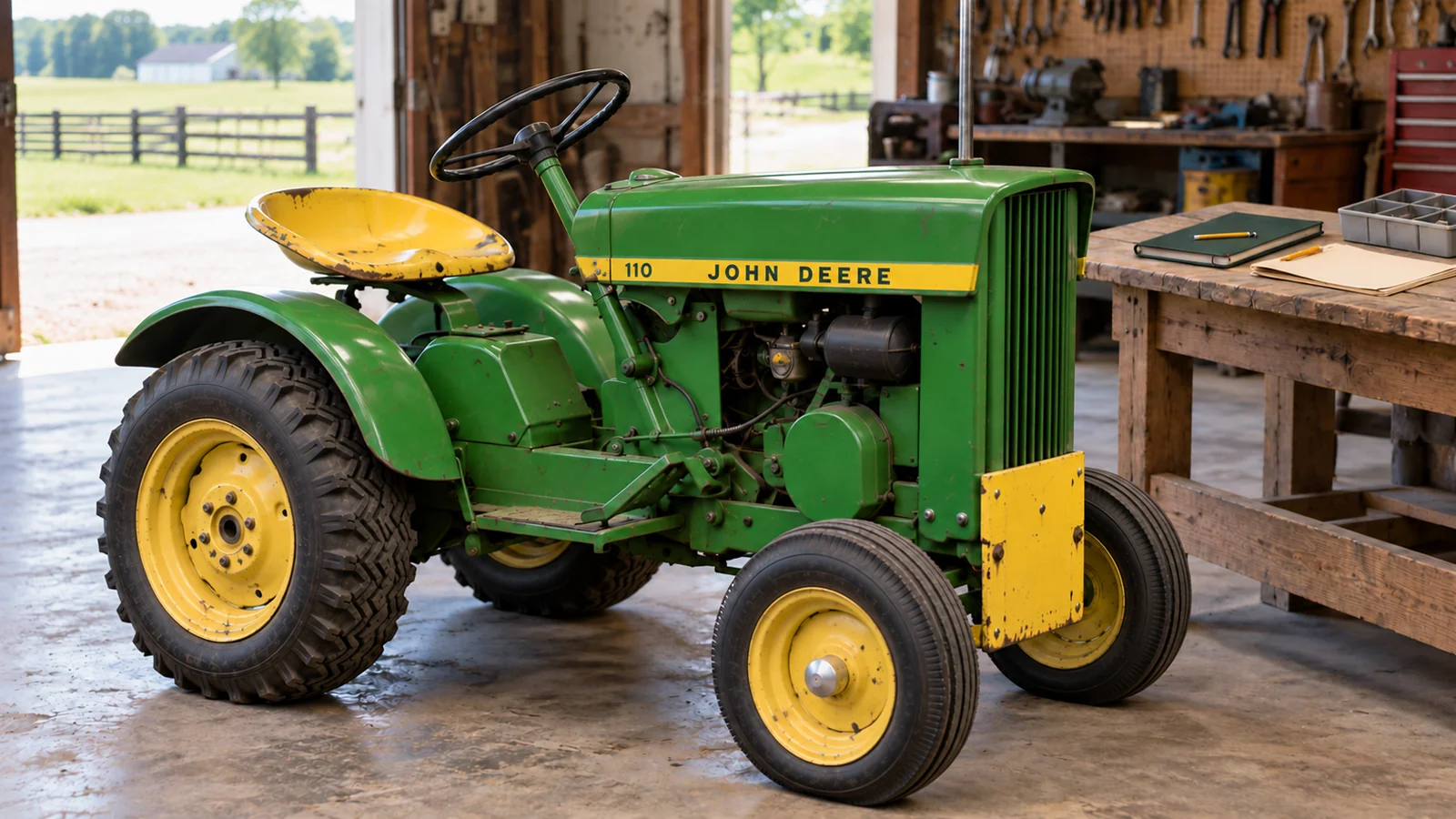
John Deere’s history can help orient the search. In , Deere describes the 110’s 1963 introduction at Horicon and its first-issue 7 hp Kohler engine with a Peerless three-speed variable drive. Those are historical first-issue details. They do not establish what is installed on a tractor offered today.
Build an identity record for the complete project
Start a record for the particular machine, keeping readable identifiers separate from a seller’s description. Include:
- Tractor model and serial information, with a clear photograph of the identification marking where available.
- Installed engine identification and any documented replacement history.
- Identification of the mower deck and each attachment included in the sale or project.
- Photographs of the complete tractor and loose assemblies, with the seller’s account of what is included.
- The publication title, edition and applicable model or serial range used to interpret the equipment.
Optional small-hardware record storage
Optional storage for already separated small hardware. Keep its recorded assembly and unresolved identity with the project record; no tractor or replacement-part fit is established.

Akro-Mils 10144 cabinet for project hardware records
Use the 44 clear drawers to separate small hardware already associated with a project record. Keep each group linked to its recorded assembly; the cabinet does not identify a part or establish replacement fit.

As an Amazon Associate I earn from qualifying purchases.
If a marking cannot be read, record it as unknown. A resemblance to an archive photograph is a lead to investigate, not a substitute for an identifier. Keep an uncertain model attribution open rather than assigning specifications from the nearest-looking tractor.
The site’s 110 guide, 112 guide and 140 guide provide separate model-oriented starting points. Use the vintage lawn-and-garden tractor index when the model remains unresolved. Neither a model guide nor a historical photograph confirms that a replacement engine, deck or attachment will fit your project.
Compare the unknowns before comparing asking prices
Use the same record for each project. An advertised price leaves the scope unresolved if the included equipment, missing assemblies or required work are still unclear.
| Question | Record for each project | Verification still needed |
|---|---|---|
| What is the tractor? | Readable identifiers and the seller’s claimed model | Resolve any conflict before choosing model-specific instructions or parts |
| What is included? | Identified assemblies and photographs of loose items | Confirm the complete package with the seller |
| What is missing or uncertain? | Each absent or unidentified assembly | Establish the exact assembly before seeking a replacement |
| What is its mechanical condition? | Existing inspection findings, their date and who made them | Ask for assessment of unresolved systems; do not turn appearance into a diagnosis |
| What does the intended result require? | A written finish or use objective | Identify the work and evidence that objective still needs |
| What would outside work involve? | A dated written scope or quote, if obtained | Confirm exclusions, unresolved diagnosis and the equipment covered |
An unknown leaves a question open. It does not prove that a machine is defective, and that part of the project cannot yet be compared on evidence. Keep a project on hold when its identity or a required assembly remains unresolved; another seller’s apparently similar tractor does not answer the missing question.
Separate cosmetic work from mechanical decisions
Describe visible condition without treating it as an operating assessment. Record damage or missing pieces you can identify, then keep the question of mechanical condition in a separate part of the worksheet. New paint supplies no inspection result for an engine or drive system.
For each proposed replacement, move from the identified assembly to the applicable parts record. Record the original part number, any documented substitution and the stated application limits. A listing headed with a familiar model number is insufficient evidence for an installed replacement engine or an unidentified deck.
Parts feasibility remains item-specific. Ask about the exact component and retain the response date; this guide makes no claim that vintage parts are readily available. Do not turn a historical description of one 110 into a general lift, transmission or attachment specification for the whole model range.
Before specifying service work, obtain the publication that covers the identified equipment. Deere’s is a route to that search. The portal itself does not establish that a particular manual covers your tractor. Keep unresolved publication matches with the person assessing the work.
Ask a question that someone can verify
Give a dealer, technician or collector a specific evidence question. A useful request reads:
I am assessing this tractor for [intended result]. Here are its readable identifiers, installed engine information and photographs of the included assemblies. Which publication and applicable range support this identification? The unresolved item is [assembly or discrepancy]. What additional evidence is needed before specifying work or a replacement?
Record who answered, when they answered and the source behind the answer. A collector’s photograph may help locate a detail; ask which model and configuration it depicts. A forum recollection can suggest a search, but retain a publication or other checkable basis before treating the claim as a parts decision.
If the answer is a quote for work, distinguish what was inspected from what remains conditional. Ask the assessor to name the equipment covered and any work excluded. No club membership or show visit establishes the condition of your tractor, and this guide reports no firsthand restoration or inspection.
Choose the next verification, then reconsider the scope
Finish the worksheet with one unresolved question, the evidence needed to answer it and the person or source you will ask. That might be a readable engine identifier, a confirmed list of included assemblies, or the publication range behind a claimed replacement.
After receiving the evidence, update the project record and reconsider the original aim. If a necessary question remains unanswered, keep it visible when deciding whether to buy, defer or reduce the proposed scope. The useful output is a documented next decision; no model name alone provides a restoration plan.
I’m not into tractors, but I love the community aspect you mentioned! It’s great to see people connect over shared interests, even if it’s not my thing. 😊
Thanks for the positivity, Nina! Communities like this can be really enriching.
It’s all about the connections! That’s what makes it special.
I wish I had my grandfather’s old tractor. He had a 1948 model that he used for everything. I didn’t appreciate it when I was younger. 😞 Now I just want to find one like it!
Sorry to hear that, Greg. Keep an eye out at local shows or swap meets. You might find a similar model!
They pop up more often than you’d think! Just have to keep looking.
I remember my grandpa had a John Deere tractor, and we’d ride around the farm. It was the highlight of my summers! This article really brings back memories. 🌾
Thanks for sharing, Cassie! Those memories are priceless. Do you have any photos of that tractor?
Such a great way to bond with family! I think these vintage tractors really do have a nostalgic value.
Honestly, I think vintage tractors are overrated. They’re cool to look at, but modern tractors are way more efficient. Why would I want to deal with maintenance issues from old machines?
That’s a fair point, Dave! Efficiency is key in today’s farming. But there’s definitely an appeal to the nostalgia!
I get that, but there’s something special about the craftsmanship of older models. They have a soul! ❤️
I just love the charm of vintage tractors! They have so much character compared to modern ones. I recently bought a 1965 John Deere 110, and I’m obsessed with it! 😍 Anyone else have one? How do you maintain them?
Hi Linda! Congrats on your 110! They’re fantastic machines. Make sure to check the hydraulic fluid regularly!
I’ve got a 1968 model, and let me tell you, it’s a labor of love! Regular oil changes and keeping the battery charged is key. How’s yours running?
I’ve been thinking of getting one too! Is it hard to find parts for these older models?
It’s amazing how these tractors have stood the test of time. They really are a legacy. I think it’s important to keep that history alive!
Absolutely, Carl! Each tractor has its own story.
So true! It’s up to us to share those stories and preserve them.
I’ve always been fascinated by the stories behind these tractors. Anyone know if there are any documentaries on John Deere’s history? Would love to watch something like that!
I think there are a few on YouTube! Just search for ‘John Deere history’.
That’s a great idea, Michelle! I’ll look into it and see if I can find some recommendations.
Can we talk about the restoration tips section? Super helpful! I never knew where to start with my old tractor. I’ve been too scared to touch it until now!
Totally relate! The fear of messing things up can be paralyzing.
Glad you found it helpful, Ethan! Just take it step by step.
I just restored a 1953 John Deere A! It took me ages, but it was so worth it. It runs like a dream now! Any other restorers here?
That’s awesome! I’d love to see pics of your restoration! Maybe I’ll try tackling one myself.
Congrats on the restoration, Samantha! That’s quite a project. What was the hardest part for you?
Wow, I had no idea John Deere had such a cool history! 😮 I always thought they just made lawn mowers. I think I might start a collection! Anyone have tips on where to look for these vintage beauties?
I found mine on Craigslist! You just have to search often and be patient. Good luck!
Great to hear, Tommy! Local auctions and estate sales are great places to find vintage tractors.
These tractors are like pieces of art! I’m not a farmer, but I love collecting vintage things. Something about their design just speaks to me. 🎨
Same here! The craftsmanship is just unmatched with these older models.
Do you have a collection already? I’d love to see what you have!
Absolutely, Ava! They really are iconic pieces of machinery.