Choose a small farm tractor by the jobs it must finish, the places it must reach and the implements it must operate. Compare complete configurations, then check operator fit and ownership support. Use horsepower and features within those checks, rather than as a substitute for them.
1. Define the work before comparing engine power
List the recurring jobs and the most demanding occasional job separately. For each, record the material, required result, available working time and intended implement. Mowing a finished lawn, cutting pasture and moving material create different requirements even on the same acreage.
treats engine and PTO power, loader and rear-hitch capacity, hydraulic flow, transmission and tires as separate selection fields. Use implement requirements to decide which field matters for each job. Do not substitute engine horsepower for required PTO power or assume a larger engine resolves a hydraulic or clearance mismatch.
| Job to price and demonstrate | Evidence to request | A reason to pause the purchase |
|---|---|---|
| Mow or cut vegetation | Intended mower/cutter, material, required finish and compatible tractor requirements | Implement suitability or the required output is unconfirmed |
| Move material with a loader | Material/load, attachment, intended load position and required lift height | Only a headline lift figure is available |
| Work with a rear implement | Exact implement requirements and proposed tractor configuration | Hitch, PTO or hydraulic requirements remain unresolved |
| Travel between work areas | Complete-machine dimensions, route and surface conditions | The assembled configuration cannot be confirmed for the route |
Use acreage to describe the property, not as a universal horsepower formula. If one rare job drives a much larger purchase, compare hiring that work or renting suitable equipment before committing to the whole ownership package.
2. Check the complete configuration against the property
Record the narrowest access, overhead obstructions, turning space and storage opening. Include the proposed tires, loader, bucket or other attached equipment in the clearance check. A bare-tractor dimension or wheelbase does not describe every assembled configuration.
Describe slopes, soft ground, drainage, sensitive turf and the route used to reach each job. Ask the dealer to assess suitability with the applicable manuals and proposed equipment. Four-wheel drive, a compact frame or a particular tire tread does not establish a safe slope limit or guarantee that a tractor will avoid damage or getting stuck.
Keep transport separate from field access. If a trailer or public-road movement is part of the plan, confirm the complete equipment’s requirements with the relevant manuals, transport provider and local rules before treating it as a solved cost.
3. Verify implements, loader ratings and required options
Create one configuration list containing the tractor/PIN or exact quoted model, transmission, tires, loader, attachment and rear implements. Ask for written confirmation of hitch geometry, PTO power and speed, hydraulic flow/pressure and required controls for each implement. A shared category name alone does not complete the fit check.
Compare loader figures at the same lift height and load reference point. Deere’s Canadian 120R table publishes different full-height capacities at the pivot and 500 mm ahead of it, with a stated tractor/tire/bucket configuration. Neither number is a universal pallet payload or permission to carry that load on a slope. Require the applicable attachment, loader and tractor instructions for the actual setup. .
Check which items are included, optional or absent: couplers, hydraulic outlets, control functions, hitch adapters, mower drive arrangements and prescribed ballast equipment. Do not infer an option from a photograph or assume an advertised quick-attach system accepts every implement.
4. Try the operator station on the proposed machine
Arrange dealer familiarization with the actual configuration. Check entry, seat adjustment, pedal/control reach, visibility and whether every intended operator can understand the normal controls and safety instructions. A feature called ergonomic or easy to use does not establish individual suitability.
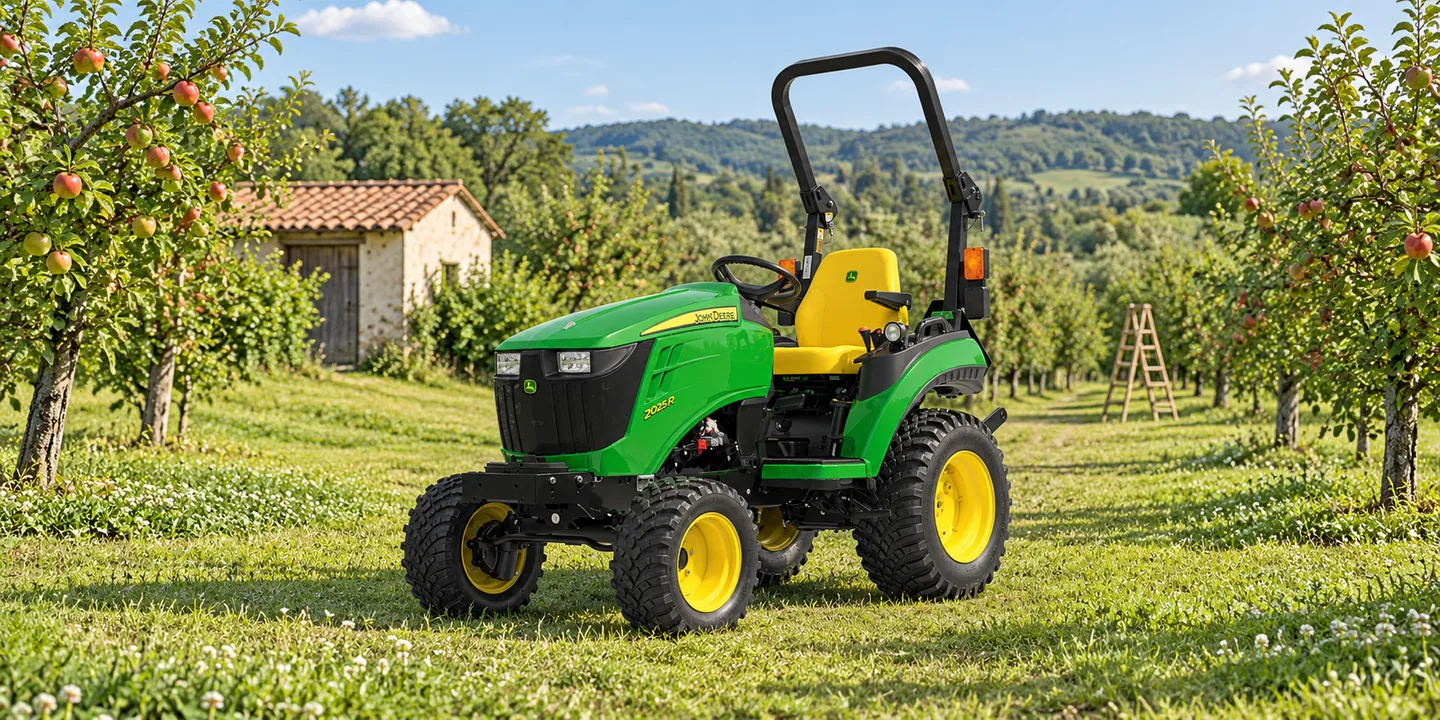
For example, Deere’s Canadian 2025R page describes hydrostatic Twin Touch foot controls. Other models, markets and generations can differ; the same page contains shared historical feature text, so use the exact unit and its manual to settle the offered specification. .
Define a demonstration outcome for each main job, such as confirming access, visibility or an implement’s required function. Have a qualified operator conduct any working demonstration under the manuals and site conditions. Do not use an improvised load or slope test to prove stability.
5. Price the ownership package and service access
Request an itemized delivered quotation, including required options, implements, setup and delivery. List storage, scheduled maintenance supplies, service travel/collection, insurance or transport costs where applicable. Mark unknown costs as unresolved and keep assumed resale values out of the comparison.
Ask where routine service points are, what owner maintenance the manual permits and what access or equipment it requires. Deere’s compact-tractor quick-reference directory separates 2025R guides by serial/model-year labels. Select the correct manual and guide before ordering fluids, filters or tools. .
Plan for accessible lubrication points
- LockNLube Easy-Prime LNL254 grease gun — A candidate when the applicable tractor or implement manual calls for greasing accessible fittings. Confirm the fitting, coupler access and specified lubricant; the tool does not establish grease type, interval or permission to approach a raised or moving attachment.
Plan fluid-service containment before buying supplies
- FloTool 42003MI drain container — A candidate for collecting service fluid when the manual permits owner service. Confirm usable capacity, drain access, fluid compatibility and the local disposal route; a container’s nominal size does not establish that it suits every tractor or service task.
These are conditional ownership tools, not required tractor options or proof that a configuration fits the farm. Do not buy a model-specific filter, belt, hose or attachment until its identity and application are confirmed.
Compare complete tractor offers on one decision sheet
| Buying check | Keep with each offer | Decision |
|---|---|---|
| Work | Main jobs, exact implements and required outcomes | Remove offers with an unresolved essential function |
| Property | Assembled clearances, route and site assessment | Pause a configuration that has not been checked against the site |
| System | Written tractor/loader/implement requirements and included options | Resolve mismatches before comparing price |
| Operator | Familiarization result and unanswered control/access questions | Choose only a configuration the intended operators can use appropriately |
| Ownership | Delivered price, required supplies/support and unknown costs | Compare like-for-like packages; retain unresolved items |
Choose from the configurations that meet the essential checks. If none does, revise the implement, scope of work or acquisition plan instead of assuming a more expensive feature list resolves the gap.
Questions to settle before placing an order
Is four-wheel drive the deciding feature?
It is one configuration choice. It does not replace the job, site, tires, implement, operator or manual checks, and it is not a guarantee of safe operation on every surface.
Does every small farm need guidance or automation?
No specific technology is required by the label small farm. Identify a job it would perform, the supported machine configuration and its full cost. Do not assume a compact tractor has CommandPRO controls, automated steering or autonomous capability.
What if the tractor works well in a dealer demonstration?
Record the demonstrated tractor, implements and conditions. Confirm that the quoted configuration matches and resolve any property-specific limits. A successful demonstration is useful evidence for that setup, not proof of every future task or a measured ownership saving.
I’m all for smart technology! But how user-friendly are these new systems supposed to be? My last tractor had tech that was more confusing than my kid’s math homework! 😂
Great question, John! The goal is definitely to make it intuitive. We’ll have to see how that pans out.
Haha, so true! The last thing we need is to spend hours trying to figure out the tractor instead of farming!
Honestly, I’m skeptical about all this ‘next big thing’ stuff. We’ve been promised so much before, but will it really change how we farm? Plus, machines can be frustrating!
Yeah, I totally get that vibe! You can’t trust marketing easily. I’ll believe it when I see it! 🙄
Totally understand, Steve! It’s important to keep a healthy dose of skepticism as new features roll out.
User-friendly controls are super important! My dad’s old tractor has buttons that look like something out of a spaceship! 🚀 Just make it simple, please!
Haha right? Sometimes simplicity is key. I’m all for easy controls over fancy features!
Smart automation? Are we really ready for that? 🚜 Sounds cool, but last time I trusted tech, my GPS sent me into a lake!
Haha, Jessica! We totally get that! It’s all about creating reliable systems.
Haha! I feel that! Hopefully, the new tech will be better than that GPS! 😂
I love the idea of compact design! Maneuvering in tight spaces is a must for my farm. I hope it’s not just talk though! Anyone know of a tractor that actually does this well?
That’s a great consideration, Emily! Keep an eye out – some models are designed specifically for small spaces!
Totally! I struggle with turning around in my fields. Compact tractors are the way to go! 🐄🚜
Versatile attachments are a must. We need something that can handle plowing in spring and hauling hay in summer! But let’s hope they don’t overcharge for the extras!
Exactly, Kevin! Versatility is essential for those of us who wear many hats on the farm.
Yes! It’s such a pain when you have to buy separate attachments for each task!
I think it’s about time we get some tractors that don’t waste fuel like it’s going out of style! Advanced engine efficiency sounds awesome! But how do you think they’ll compare in price? 🤔🤷♀️
Good point, Sarah! If they can save gas and still be affordable, that’d be a game changer! 🌱✨
Absolutely, Sarah! Fuel efficiency is key, and we’re hoping that manufacturers keep the cost reasonable too!
I’m glad they’re focusing on ergonomics. It’s not just about the machine, but how comfortable we are using it! I mean, who wants to be sore after a few hours of driving?
Exactly, Ben! Comfort can really improve productivity and keep us farmers happier!
Yes! Can’t wait to see improvements on that front! My back hurts just thinking about my old tractor!