Updated
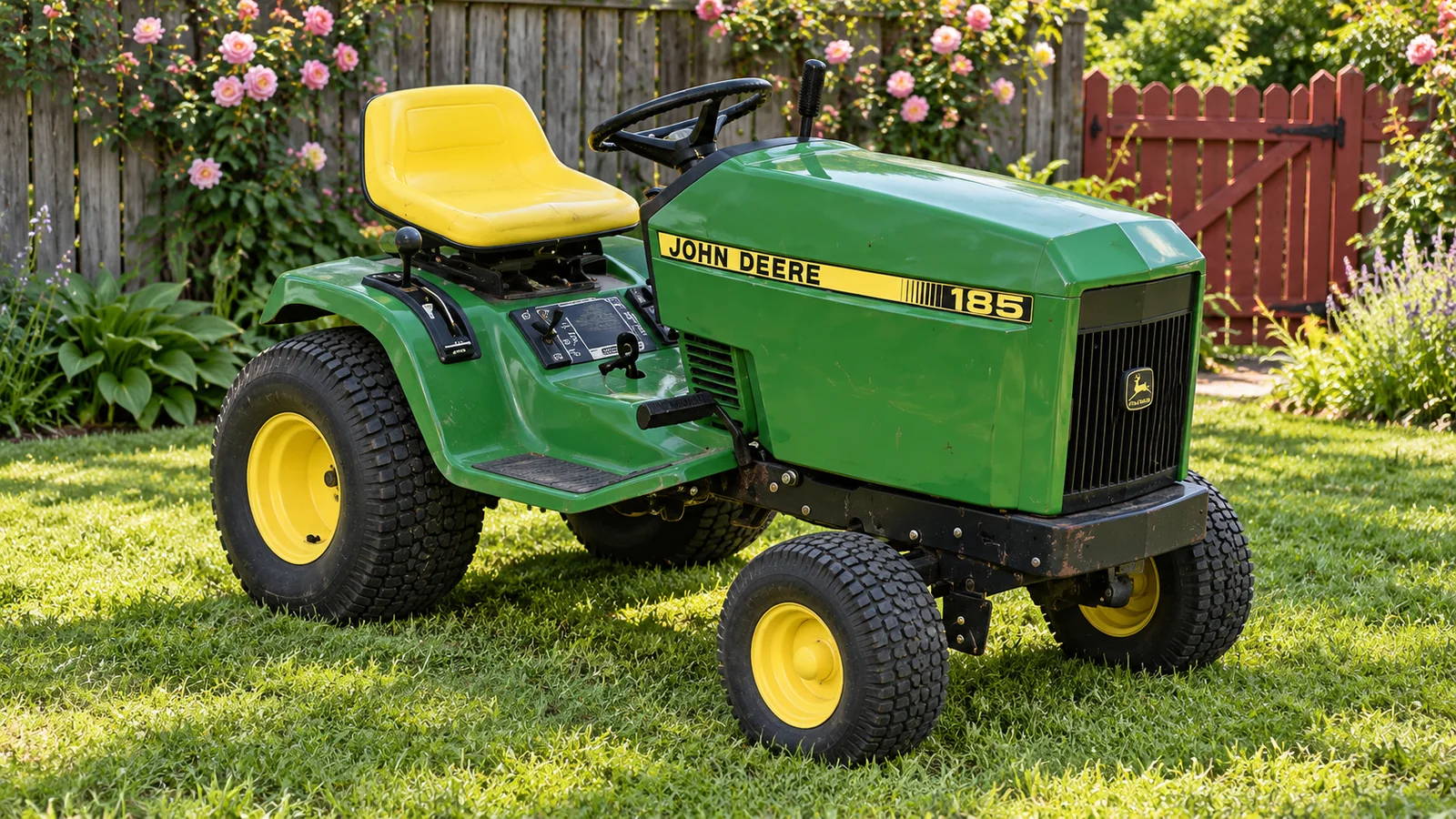
The John Deere 185 is a hydrostatic lawn tractor listed for model years 1986 through 1990. Deere's technical manual identifies its original engine as the 17-hp Kawasaki FC540V. The parts catalog lists 38-inch and 46-inch mower configurations. Before ordering parts for a surviving tractor, record its complete product identification number (PIN), the engine tag and the mower identification. An engine or deck may have been changed since the tractor left the factory.
Original engine and mower configurations
| Item | Documented configuration |
|---|---|
| Engine | Kawasaki FC540V, single-cylinder, four-cycle |
| Rated power in TM1351 | 17 hp |
| Drive | Hydrostatic |
| Model years in PC10393 | 1986–1990 |
| A mower configuration | 38-inch; identified as 970 Mower for 1986 |
| B mower configuration | 46-inch; identified as 1170 Mower for 1986 |
Engine identification
Use the engine tag when selecting engine-service parts. The FC540V identification describes the original configuration documented in Deere's TM1351; the tractor's hood decal cannot confirm which engine is installed today. If the tag identifies a replacement engine, use that engine's parts information rather than assuming a John Deere 185 maintenance kit will fit.
Deck size and blade count
PC10393 distinguishes the 38-inch A configuration from the 46-inch B configuration. TM1351's mower specifications list two blades for the 38-inch deck and three for the 46-inch deck. Blade count can help check a deck description, but it does not establish a replacement blade or belt part number. Match the installed mower to its catalog entry before buying cutting parts.
Read the whole PIN before choosing a serial range
Keep every letter and number from the tractor's identification plate. PC10393 separates the mower configurations and model-year serial ranges; a seller's description of “fits John Deere 185” does not resolve those distinctions.
The 1990 numbering is easy to misread. Deere lists these ranges for that year:
| 1990 mower configuration | Serial-number suffix range |
|---|---|
| A: 38-inch | 010001–100000 |
| B: 46-inch | 020001–100000 |
The preceding 1989 ranges reach 750000. A smaller suffix therefore does not automatically mean an earlier tractor. Use the complete PIN and the catalog's year/configuration table together, rather than sorting all 185 tractors by the numeric suffix alone. If a plate is unreadable, identify the assembly with a Deere dealer before choosing a serial-range-specific part.
Engine-service parts to check
Deere's LG185 Home Maintenance Kit is a useful starting point for an original-engine 185. Deere includes the model in the kit's general-fit information. That is a catalog lead: confirm the current application against the tractor PIN, engine tag and installed parts before placing an order.
Filters and spark plug
The current Deere LG185 listing identifies these components:
| Service item | Deere component number | Check before ordering |
|---|---|---|
| Engine oil filter | AM107423 | Engine application and current part-number selection |
| Paper air-filter element | M97266 | Installed air-cleaner housing and matching element |
| Foam pre-cleaner | M70127 | Correct pairing with the installed air-cleaner assembly |
| Inline fuel filter | AM116304 | Engine and fuel-system application |
| Spark plug | M802138 | Current selection for the actual engine |
The original TM1351 specification names a Champion RN11YC plug, while the current kit listing uses Deere number M802138. Those names alone do not establish an interchange or the correct gap for a changed engine. Resolve that question through the current engine application before buying or adjusting a plug.
Use the applicable operator's manual for oil grade, capacity, service intervals and service procedures. A kit's contents do not set the maintenance interval. When comparing an Amazon USA offer with the Deere selection, check the exact manufacturer and part number; a long model-fit list is insufficient if the installed engine or assembly differs.
Equipment & supplies
Oil and fuel filters to check

John Deere AM107423 oil filter
An oil-filter choice listed in Deere’s LG185 maintenance kit for the 185. Confirm AM107423 against the installed engine and current Deere selection before ordering.

John Deere AM116304 fuel filter
The inline fuel-filter number listed in Deere’s LG185 kit. Check AM116304 against the fitted engine and fuel system before ordering; a changed engine needs its own parts lookup.


As an Amazon Associate I earn from qualifying purchases.
Blades, belts and attachments
For deck parts, start with the mower identification and the relevant diagram in PC10393. Record the selected blade, belt or spindle number before searching a retailer. Check any current replacement number as well. Deck width and a similar-looking product photograph cannot resolve every assembly or serial-range difference.
A bagger, snow attachment or other accessory needs its own application check. Ask for the attachment model, required mounting parts and a documented match to the tractor and mower configuration. A listing that mentions the 185 without those details is not enough to choose the accessory. Keep an uncertain attachment out of the shopping list until its application is resolved.
Inspecting a used John Deere 185
Before travelling to see a tractor, ask the seller for clear photographs of the tractor PIN plate, engine tag, mower identification and the complete machine. Compare those records with the equipment being offered, including any deck or attachment sold separately. This also makes a parts inquiry more useful than a hood-only photograph.
For a machine in front of you, note visible damage, missing identification, modifications and missing deck guards or mounting pieces. These observations identify questions for the seller or a repair inspection; they do not establish mechanical condition. This guide contains no measured mowing, fuel-use or reliability test of an individual 185.
Keep a short record with the complete PIN, engine identification, installed mower, confirmed replacement numbers and the source/date of each lookup. Recheck that record when an engine, deck or attachment is changed. It gives the next parts search a specific starting point instead of repeating a broad model-name search.
For adjacent model records, see the John Deere 175 and John Deere 180. Their model names are different; do not transfer an engine or deck part selection to the 185 without checking its application.
Deere references
- , pages 3–5: model years, mower configurations, PIN ranges and identification guidance.
- : manual identity and covered models. The engine and mower tables used here are on printed pages 10-10-3 and 10-10-4 of a , dated 18 April 1990.
- : current component identities and general-fit lead. Confirm the current application for the installed equipment.
I bought this tractor mainly for my small farm. It does an admirable job but I feel like the power could be a bit more for some tougher jobs. Anyone use this more heavily? Curious about your thoughts.
I think the power is pretty decent, but for heavy-duty tasks, I’d recommend looking into some of the larger models.
Great to hear how you’re using it, Eli! Have you thought about any specific attachments for heavier jobs?
Just got my John Deere 185 last month, and I’m already a fan! It’s super comfy to drive and easy to maneuver. However, I want to learn more about the maintenance tips to keep it running well. Any tips? 💡
Congrats on your new tractor, Ashley! Regular checks on the oil and filters can make a huge difference.
Definitely keep an eye on the blades too! Sharp blades make the mowing much easier.
Is it just me or do the colors of the John Deere lineup just look amazing? 😂 Like, I’m motivated to mow the lawn just to sit on my tractor! Anyone else get that?
Haha! You’re not alone, Jen! A good-looking tractor can definitely boost the enjoyment of lawn work.
Right? And it’s not just about looks! Those colors are part of what makes John Deere so iconic.
Honestly, I had high hopes for this tractor, but I faced a few issues with the engine starting up. It just seems a bit unreliable at times. Anyone else have similar troubles? I might take it in for a check-up soon. 😕
Sorry to hear that, Tommy. It’s always a good idea to get it checked if you’re experiencing starting issues.
I had the same issue in the first few months but it turned out to be a spark plug problem. Might want to check that!
I’ve been using my John Deere 185 for a couple of years now, and I absolutely love it! The performance is top-notch and it really makes mowing my lawn a breeze. Plus, the attachments are a game-changer for other yard work. 🔧🌱 Has anyone tried adding a bagger to their tractor? I’m thinking about it but not sure if it’s worth it.
Glad to hear you’re enjoying your John Deere, Mark! The bagger can be really useful, especially during fall when leaves are everywhere.
I have a bagger on mine, and it works great! Just make sure you’re ready for the extra maintenance.
Tried out the John Deere 185 at my buddy’s place. It felt good to drive, but have to be honest, I was slightly underwhelmed with how it handled rougher patches. A bit bumpy! Do you all think that’s just the model or does maintenance help with that? 🛠️
It’s possible! Proper tire pressure and maintenance can make a big difference in handling.
I noticed that too, Zack. I adjusted the tire pressure, and it made my experience a lot smoother!
When it comes to ease of use, I’m all in! The John Deere 185 is super user-friendly—not just for lawn work but also for hauling little stuff around. Perfect for my suburban lifestyle. Anyone else use it for other non-mowing chores?
I use mine to haul dirt and debris, works like a charm! It’s definitely more than just a mower.
Glad you’re finding it versatile, Sammy! It really is a solid option for various tasks.